







For years, NX buyers faced a frustrating choice: get the efficient hybrid and settle for a plain-Jane luxury trim, or go F-Sport and sacrifice fuel economy for a turbocharged four-cylinder. Lexus has finally fixed that. The 2026 Lexus NX 350h F-Sport is the first time the brand has offered its bread-and-butter hybrid powertrain inside the sportier F-Sport handling package — and after a full week behind the wheel, it’s clear this is the NX most buyers should want.
That said, “the NX we always wanted” doesn’t mean “a perfect car.” There are real tradeoffs here, and for nearly $60,000 as tested, buyers deserve to know exactly what they’re getting — and what they’re not.
Contents
Quick Specs at a Glance
Why the NX 350h F-Sport Matters in 2026
The Lexus NX has been the best-selling compact luxury SUV in America for several consecutive years — outselling the BMW X3, Mercedes-Benz GLC, Audi Q5, and Genesis GV70. That’s not a fluke. Lexus figured out a formula that American buyers respond to: reliability-adjacent build quality, respectable fuel economy, and a design language bold enough to turn heads without alienating anyone. With nearly 77,000 units sold in the U.S. in 2025 — the NX’s best sales year on record — it’s hard to argue with the approach.
But 2026 brings meaningful change to the lineup. Lexus dropped the base NX 250 (which was powered by a naturally aspirated 2.5-liter shared with the RAV4) as that engine exits production following Toyota’s move to an all-hybrid RAV4. The NX 350h, once the mid-tier powertrain, is now the entry point. And critically, Lexus has made it available with the F-Sport handling package for the first time — giving buyers something genuinely new to consider.
Exterior Design
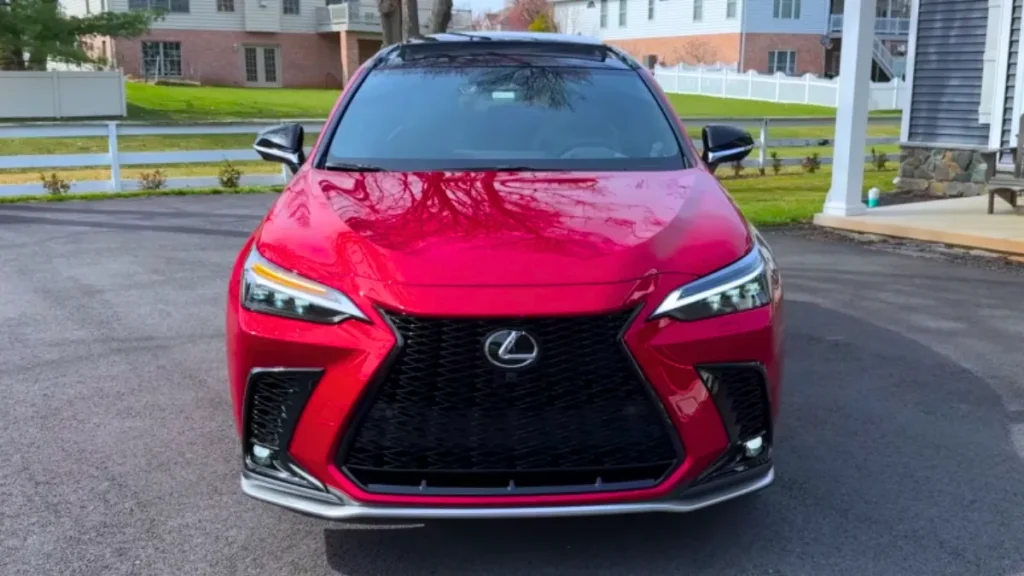
Lexus hasn’t given the NX a visual refresh for 2026, and it shows. The car still wears the second-generation body introduced back in 2022 — spindle grille, blade LED taillights, boldly spelled-out “LEXUS” across the trunk lid. It’s a look that aged well, but if you’re hoping for something genuinely new on the outside, a 2027 refresh is widely expected.
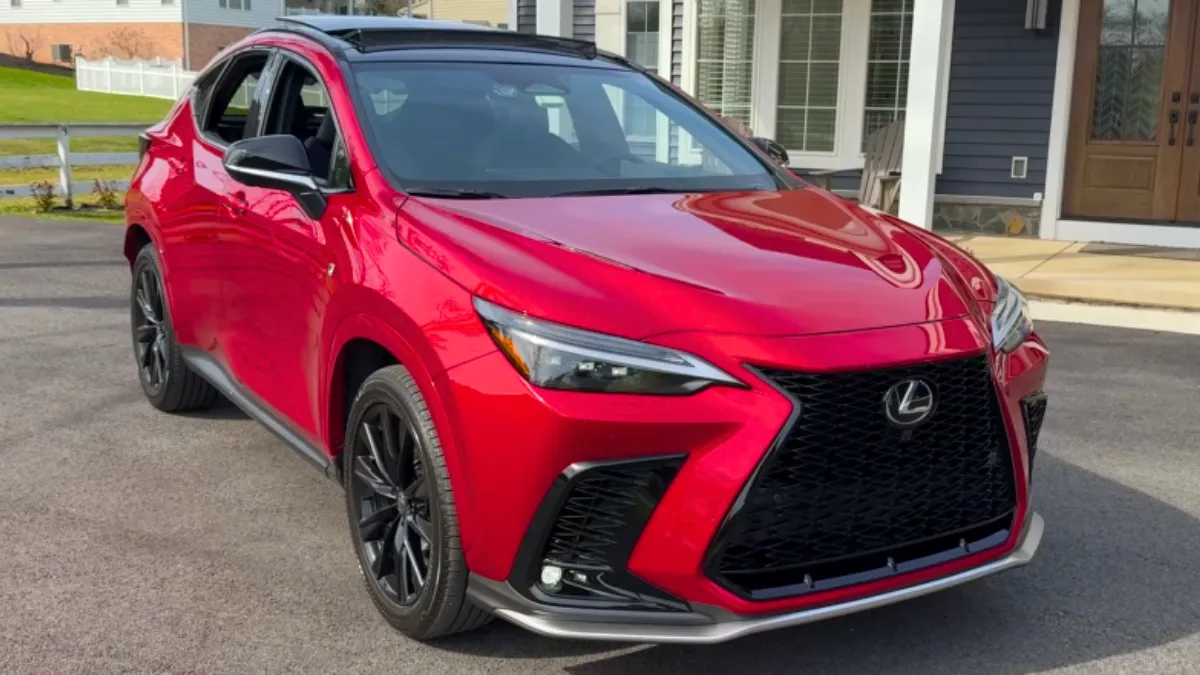
What the F-Sport handling package does add to the exterior is substantial, though. The spindle grille gets a more intricate mesh pattern — almost predatory up close — with a silver front splitter and LED fog lights giving the front fascia a meaner stance. Out back, the diffuser is slightly more aggressive, though curiously, the only F-Sport badge on the whole car appears on the front fender. For a nearly $60,000 vehicle, the badging strategy feels weirdly restrained.
The test car arrived in Infrared, a metallic red with subtle sparkle that photographs beautifully and looks even better in direct sunlight. It pairs well with the F-Sport’s exclusive gloss black 20-inch wheels — a double five-spoke design on Bridgestone Alenza all-season rubber. One minor complaint: those 20-inch rotors deserve painted red brake calipers. They don’t have them. At this price, they should.
Body dimensions land at 183.5 inches long on a 105.9-inch wheelbase, making the NX roughly 2.5 inches longer than the new RAV4 while sharing nearly the same footprint. It rides about four inches wider and sits a touch lower, giving it a planted, athletic profile that’s genuinely flattering from the side — and, at certain angles, strikingly similar to a Mazda CX-5 in the best possible way.
Interior & Technology
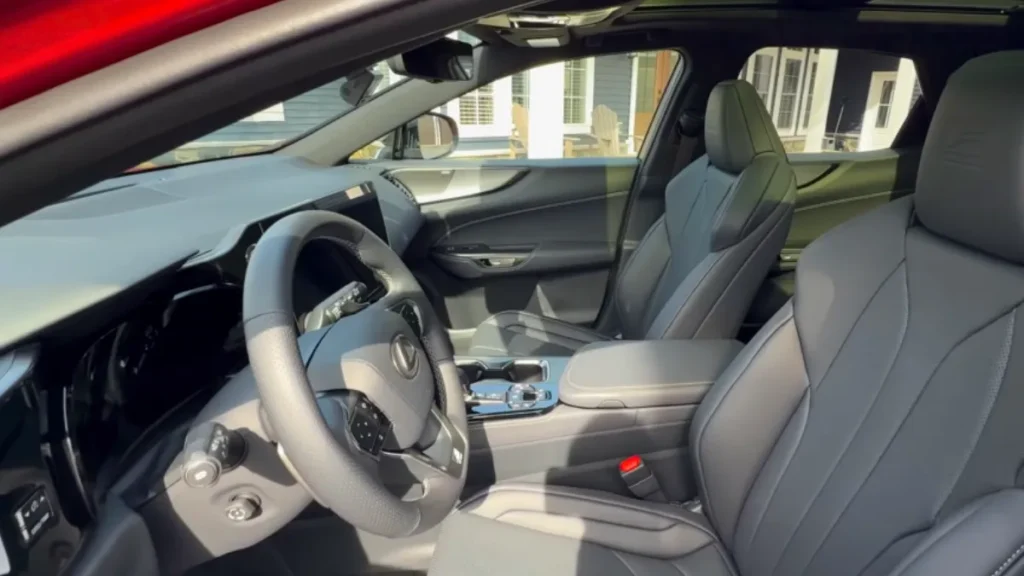
Step inside the F-Sport and the first impression is strong. The steering wheel is F-Sport specific with a flat bottom and paddle shifters. The seats feature more aggressive side bolstering than standard trims — they’re heated and ventilated as standard — and the optional Mark Levinson 17-speaker sound system ($1,000) sounds genuinely impressive for a vehicle in this class. The aluminum sport pedals and sill plates reinforce the performance aesthetic without feeling like aftermarket add-ons.
Infotainment: Improved, But Not Perfect
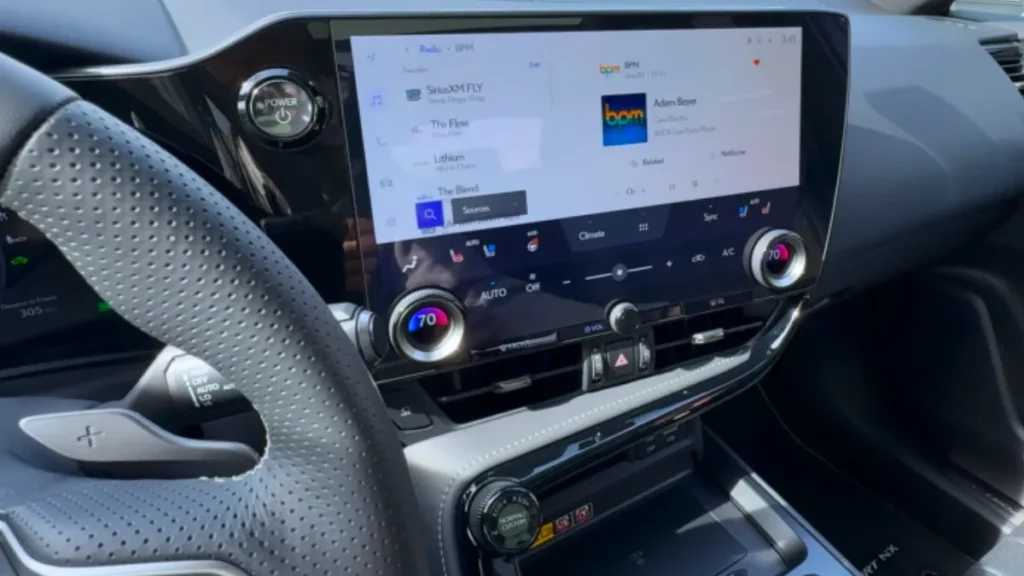
The 14-inch infotainment screen — wireless Apple CarPlay and Android Auto included, with built-in cloud-based navigation — is snappy and relatively intuitive. It’s an inch larger than the RAV4’s top-spec display, and the interface has improved considerably since the NX’s 2022 debut. That said, the base screen on the NX is now 9.8 inches, which is actually smaller than the RAV4’s standard unit — an odd reversal given the Lexus premium.
A Dated Instrument Cluster
Here’s where it gets complicated: the instrument cluster hasn’t been updated. It’s still an 8-inch digital display that looks dated alongside the large center screen — especially compared to the full 12.3-inch clusters in the Lexus RX and TX. There’s no full digital gauge pod here, and in 2026, that omission is noticeable. Every indication points to a revised cluster when the 2027 refresh arrives, but that doesn’t help current buyers.
Small Annoyances That Add Up
Other friction points: the wireless charging pad occasionally overheated our test phone and didn’t always initiate charging reliably. And there’s an excess of piano black plastic trim on the center console that attracts dust and fingerprints like a magnet — unchanged from launch year. These aren’t fatal flaws in a $45,000 car. In a $59,000 one, they’re worth naming.
Rear Space and Practicality Trade-Offs
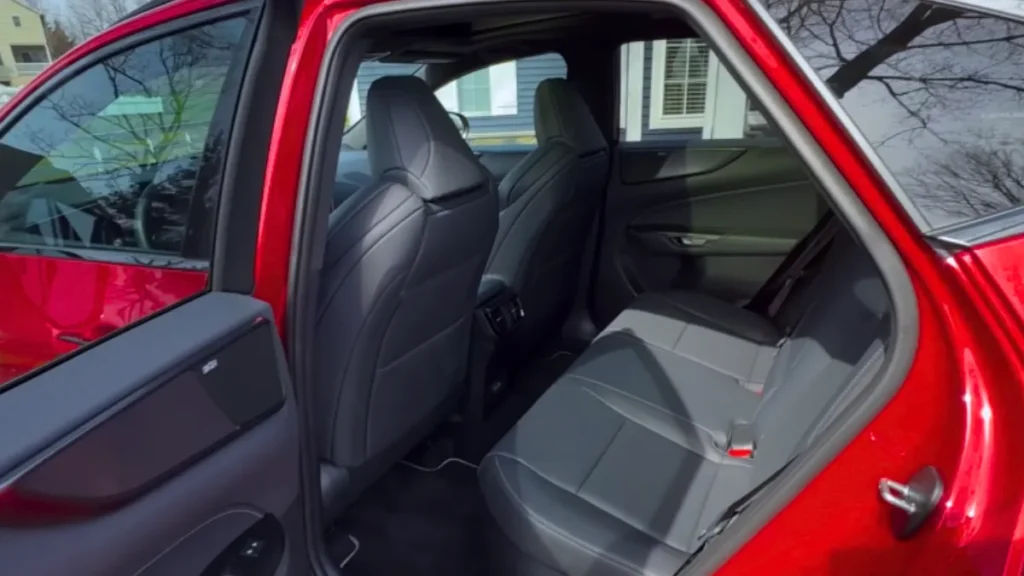
Rear seat space is the NX’s most significant packaging compromise. At around 36 inches of rear legroom, passengers lose roughly 1.8 inches versus what they’d find in the RAV4. For average-sized adults on typical trips, it’s fine. For tall passengers on long journeys, it’s tight. Cargo capacity at 22.9 cubic feet (46 cubic feet with seats folded) reads low on paper — and while Lexus may measure differently than competitors, the sloping roofline genuinely does eat into usable space. Families hauling sports equipment or strollers will feel the pinch.
Performance & Powertrain
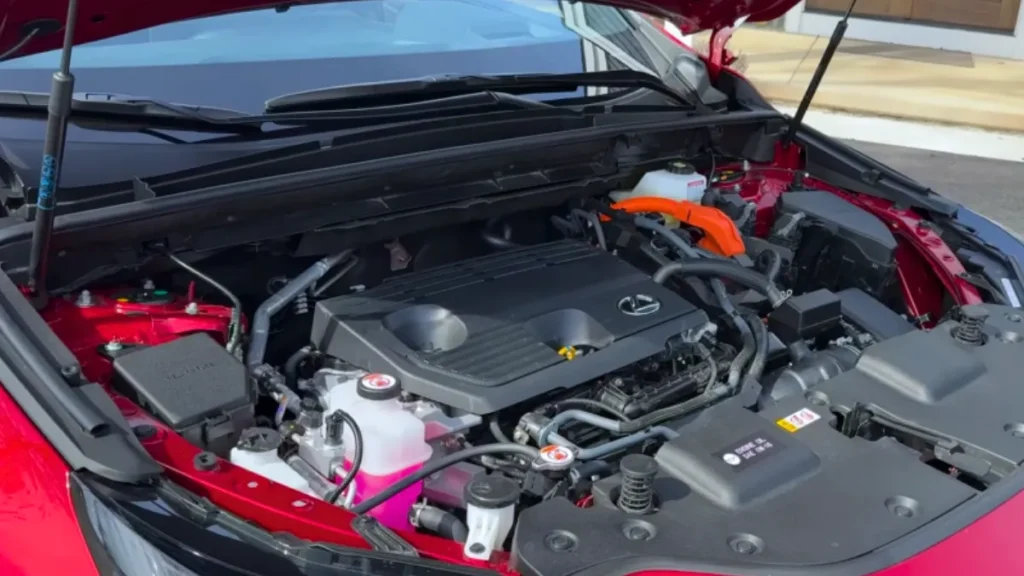
The 350h designation covers a 2.5-liter naturally aspirated four-cylinder with port and direct injection, paired with up to three electric motors (two at the front, one at the rear axle on AWD models). Lexus rates total system output at 240 horsepower — four more than the latest hybrid RAV4 — routed through an electronic CVT. The AWD version is $1,500 over the new front-wheel-drive base, and that’s money almost everyone should spend.
On paper, Lexus claims 7.2 seconds to 60 mph. In our brake-torqued runs on flat ground, we recorded 6.6 seconds — noticeably quicker than the luxury trim NX 350h we tested previously (6.8s), and legitimately close to the turbocharged NX 350’s 6.4-second time from a few years back. More typical real-world launches without brake-torquing land around 7.0 seconds consistently, which is more than adequate for a family SUV.
The powertrain’s real strength isn’t the headline number — it’s the everyday character. The ECVT is smooth and responsive in a way that CVTs in most economy cars simply aren’t. Transitions between electric and combustion modes are nearly imperceptible at moderate throttle inputs, and the system excels in stop-and-go urban traffic where the hybrid architecture earns its keep most visibly. In city driving, we averaged close to 39 mpg — impressively near the EPA estimate.
Highway efficiency tells a different story. With a heavier right foot on longer stretches, our week of mixed driving averaged around 32 mpg — well below the EPA’s 37-highway claim. The larger 20-inch wheels and performance tires likely contribute to the efficiency drop, and the 14.5-gallon fuel tank means real-world range is closer to 400 miles than the theoretical 550-mile figure Lexus promotes. Buyers who primarily drive highways should factor this in.
Driving Impressions
The addition of adaptive variable suspension to the 2026 Lexus NX 350h F-Sport is the handling package’s most meaningful mechanical contribution. In Normal mode, the dampers absorb road imperfections with the kind of quiet composure that’s been the NX’s signature since 2022. Switch to Sport Plus and the steering sharpens noticeably — response becomes quicker and more direct — while the suspension firms up enough to discourage body roll on back-road runs without ever beating up passengers.
Whether Sport Plus is dramatically different from Normal depends on the road. On smooth pavement, the distinction is subtle. On broken surfaces where the suspension really works, the Sport setting’s added composure becomes genuinely apparent. The larger 20-inch wheels don’t compromise ride quality to a punishing degree — a meaningful achievement that reflects the quality of Bridgestone’s Alenza all-season compound as much as Lexus’s chassis tuning.
The one persistent frustration with the powertrain is engine noise at high RPM. Push past 4,000 RPM — something that happens regularly on highway on-ramps — and the naturally aspirated four-cylinder becomes noticeably intrusive for a vehicle with Lexus aspirations. The turbocharged NX 350 avoids this problem by making its power lower in the rev range. And the plug-in 450h+ sidesteps it by running on battery power more often. The 350h is caught in the middle: more efficient than the turbo, but noisier than either alternative at full stretch.
The F-Sport’s paddle shifters simulate gear changes through the CVT but lack the mechanical conviction to genuinely engage a driver. They’re there if you want them; most buyers will leave them alone after the first week. Interior refinement otherwise impresses — no squeaks, no rattles, excellent wind isolation, and a cabin that remains genuinely quiet until the engine note intrudes.
Pros & Cons
PROS
- First-ever 350h + F-Sport handling combination
- 39 mpg combined (EPA); shines in city driving
- Adaptive variable suspension: comfortable but capable
- 240-hp system output; real-world 6.6s 0–60
- Strong build quality, zero squeaks or rattles
- Excellent 14-inch infotainment; wireless CarPlay/Android Auto
- Heated/ventilated front seats standard on F-Sport
- Mark Levinson audio is genuinely impressive
- Quieter cabin than previous-gen RAV4
CONS
- Engine gets noticeably noisy above 4,000 RPM
- Outdated 8-inch instrument cluster (digital, but small)
- Rear legroom trails class average by ~2 inches
- 22.9 ft³ cargo lags most direct rivals significantly
- Wireless charger unreliable; tends to overheat phones
- Excess piano black trim shows dust/scratches easily
- Heated rear seats are a $1,000 option — not standard
- Real-world highway mpg lands well below EPA estimates
- No 2,000-lb tow rating can’t match RAV4’s 3,500 lb
How It Stacks Up Against Key Rivals
| Model | Power | MPG (combined) | Cargo (behind row 2) | Starting MSRP |
|---|---|---|---|---|
| 2026 Lexus NX 350h F-Sport (AWD) | 240 hp (system) | 39 mpg | 22.9 ft³ | ~$56,000 |
| 2026 BMW X3 (xDrive30) | 255 hp (turbo 4) | 27 mpg | 28.7 ft³ | ~$48,000 |
| 2026 Mercedes-Benz GLC 300 | 258 hp (turbo 4) | 26 mpg | 22.1 ft³ | ~$50,000 |
| 2026 Audi Q5 (45 TFSI) | 261 hp (turbo 4) | 25 mpg | 25.1 ft³ | ~$47,000 |
| 2026 Genesis GV70 (2.5T AWD) | 300 hp (turbo 4) | 26 mpg | 28.9 ft³ | ~$44,000 |
| 2026 Acura RDX (SH-AWD) | 272 hp (turbo 4) | 24 mpg | 29.5 ft³ | ~$42,000 |
The NX’s competitive advantage is almost entirely tied to its hybrid powertrain. No other vehicle in the compact luxury SUV segment offers a conventional (non-plug-in) hybrid option — the 2026 Lexus NX 350h F-Sport is a genuinely unique proposition. Rivals hit harder on raw horsepower, available cargo volume, and in many cases rear seat space. But none of them touch 39 mpg combined with all-wheel drive. For buyers who spend significant time in city traffic, that efficiency gap is worth real money over a three-year ownership cycle.
The Genesis GV70 arguably offers the most car for the least money. The BMW X3 remains the driver’s choice. But the NX’s residual values, reliability reputation, and running cost advantage help justify its position — and at $59,000 as tested, it’s still $3,000–$6,000 less than a comparably equipped GLC or X3 at that spec level.
Pricing & Value
The 2026 NX lineup restructure pushes prices up meaningfully. The entry-level NX 350h with front-wheel drive starts just over $46,000 — roughly $4,000–$5,000 more than the discontinued NX 250 it replaced. All-wheel drive adds $1,500. The NX 350 turbo with standard AWD is about $900 less than the 350h AWD — an interesting reversal from earlier years when the turbo commanded a premium.
The F-Sport handling package represents roughly a $2,500 premium over the Luxury trim, bringing standard adaptive dampers, the sportier aesthetics, and upgraded seat bolstering. Our test car loaded with the Mark Levinson audio, panoramic roof, head-up display, and premium screen stickered at just under $59,000. That’s a lot of money for what amounts to an upmarket compact crossover.
The honest comparison: a fully loaded RAV4 XSE Hybrid approaches $45,000. You’re spending roughly $14,000 more for the Lexus. What do you get for that premium? Better sound insulation, tighter fit-and-finish, more powerful audio, the F-Sport’s suspension package, and the Lexus brand experience — which, for many buyers, includes resale value that tends to outperform the segment. Whether that calculus works for any individual buyer is personal. But calling it overpriced without context isn’t fair either.
Final Verdict
The 2026 Lexus NX 350h F-Sport delivers exactly what it promises: the efficiency of the hybrid drivetrain, the visual and dynamic attitude of the F-Sport package, wrapped in Lexus’s characteristically well-assembled interior. It’s the NX that should have existed from the start, and for buyers who’ve been waiting for this specific combination, the wait was worth it.
But it’s not without rough edges. The instrument cluster belongs in a 2022 car, not a nearly $60,000 2026 model. The engine gets surprisingly loud when pressed. Rear seat and cargo compromises that felt minor three years ago look more significant now that Genesis, BMW, and Acura have all upgraded their packaging. And wireless charging that overheats your phone is simply unacceptable at this price.
If you’re buying today, the NX 350h F-Sport is still the most balanced, fuel-efficient, and well-rounded option in the segment. If you can wait — a 2027 refresh with a full digital cluster and updated interior tech looks increasingly likely. Either way, the formula Lexus has built here remains genuinely compelling. It just needs one more year in the oven.
Frequently Asked Questions
The most significant change for 2026 is the availability of the F-Sport handling package with the 350h hybrid powertrain — a combination Lexus had never offered before. Lexus also dropped the base NX 250 model, making the NX 350h (now available in front-wheel drive for the first time) the new entry-level option. The exterior design and interior layout are otherwise largely unchanged from the 2022 redesign.
The F-Sport handling package adds roughly $2,500 over the Luxury trim and delivers adaptive variable suspension, sportier exterior styling (including the gloss black 20-inch wheels and more aggressive front fascia), unique F-Sport interior appointments, and a specific steering wheel with paddle shifters. If you value handling dynamics and aesthetics over maximum interior space and a quieter driving experience, the F-Sport upgrade is worth the ask.
The NX 350h AWD is EPA-rated at 39 mpg combined — about 2–3 mpg less than the 2026 RAV4 Hybrid AWD. In real-world testing, city driving came close to the EPA estimate, while highway efficiency dropped to the low 30s. The RAV4 also offers better cargo capacity and towing (up to 3,500 lbs vs. the NX’s 2,000 lbs), but lacks the NX’s refinement, interior quality, and Lexus ownership experience.
All signs point to a 2027 NX refresh, likely bringing a full digital instrument cluster, updated interior software, and potentially revised exterior styling — following the same development cadence Lexus has used after the Toyota RAV4 platform updates. If the outdated 8-inch driver’s display bothers you and you’re not in a hurry, waiting another model year is a reasonable move. If the F-Sport hybrid combination is exactly what you need right now, the 2026 model is a thoroughly sorted, road-tested product that’s unlikely to disappoint.