








There’s something deeply odd about a car that can humiliate a BMW M3 at a stoplight but also makes you think fondly of a Subaru Crosstrek. The 2026 Volvo EX30 Cross Country is that car. It’s a subcompact electric SUV barely longer than a Golf GTI — yet it packs 422 horsepower, all-wheel drive, all-terrain tires, and skid plates. Whether that combination makes any rational sense is a question Volvo seems to have stopped asking. The answer, after a full week of testing and a surreal afternoon sliding this thing around a frozen Ottawa River in Quebec, is: it doesn’t matter. It works anyway.
When Volvo unveiled the EX30 roughly two years ago, the pitch was compelling if slightly optimistic, as highlighted in the official EX30 specifications available on Volvo’s website: under $35,000, around 275 miles of range, and enough personality to remind Americans that compact Volvos once existed. The C30 hatchback, discontinued after 2013, remains one of the most underappreciated sporty small cars of its era. The EX30 was supposed to be its spiritual successor. Then came production delays, price increases, a factory move from China to Belgium, and a range figure that landed notably south of the original promise. For 2026, Volvo is adding two new trim configurations — a more accessible single-motor, rear-drive variant starting at $40,345, and this, the Cross Country. It’s the first time Volvo has ever applied the Cross Country treatment to an electrified model, and it opens up a genuinely interesting niche: the micro adventure EV.
“Pull up next to an unsuspecting Supra at a red light. When the light goes green, wave politely from your tiny Swedish SUV as it disappears into the distance.”
Contents
Exterior Design
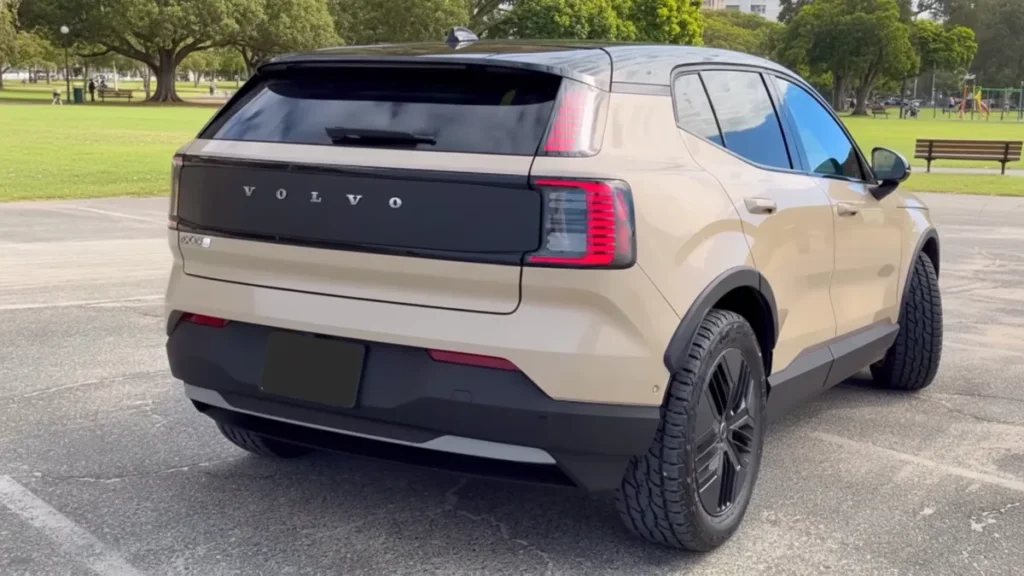
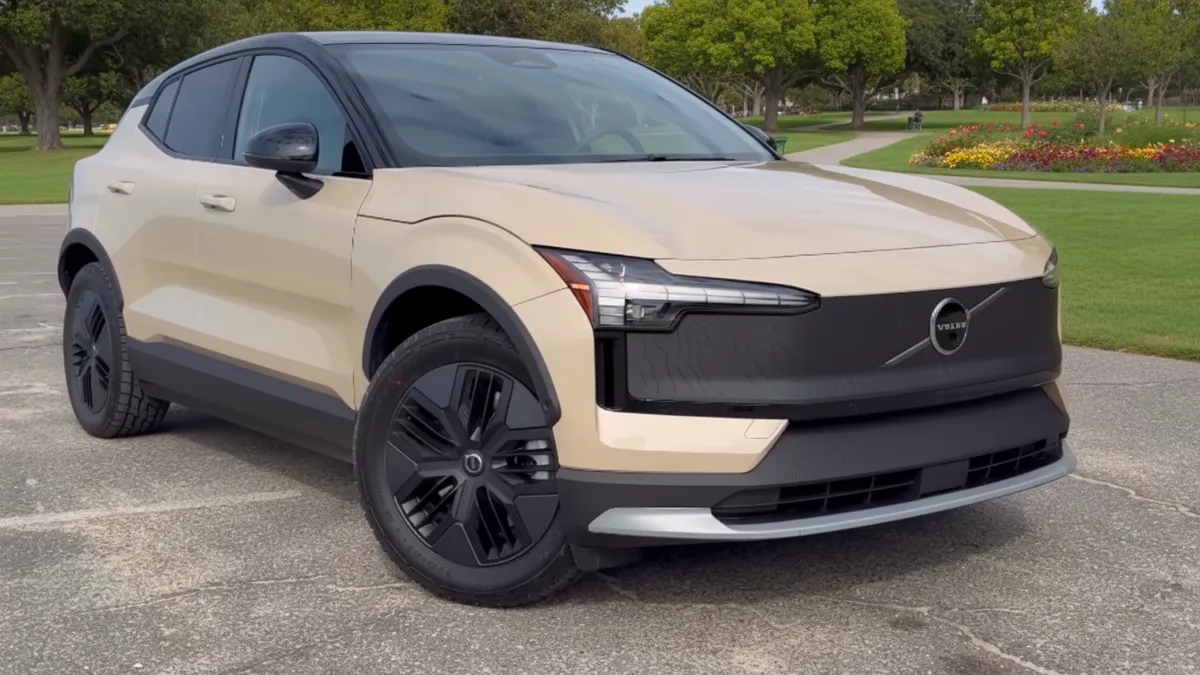
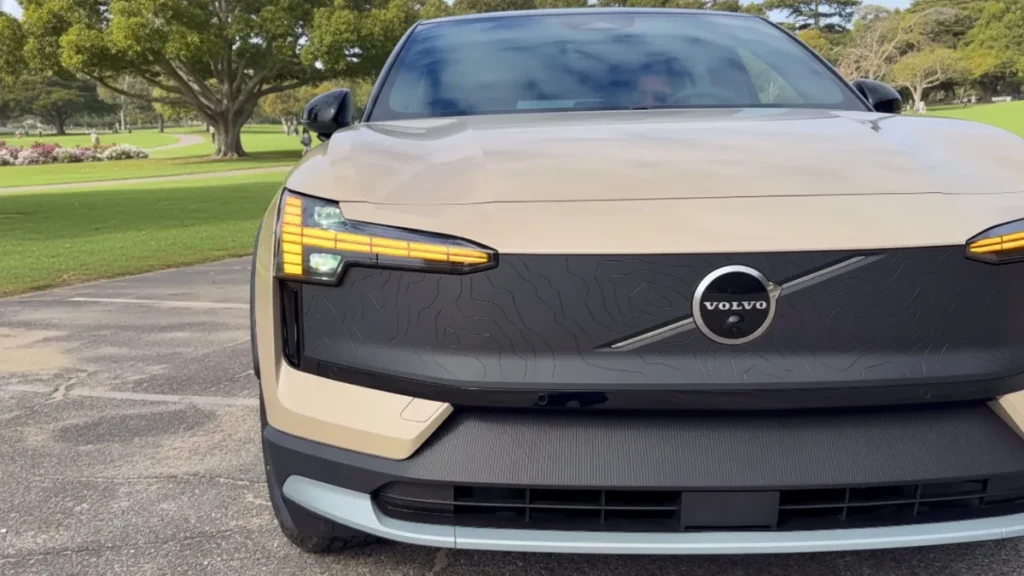
The Cross Country differentiation is more than a sticker job. Volvo gave this thing a genuine visual identity: chunky wheel arch cladding, an aggressive front fascia with a textured plastic “grille” panel that hides the topographic coordinates of Sweden’s highest mountain peak, and a metallic skid plate aesthetic front and rear. Ground clearance climbs from 7.0 inches on the regular EX30 to 7.7 inches here — a modest 0.7-inch lift, but it reads on the road as more substantive than the numbers suggest.
Our test car arrived in Sandstone Pearl, a muted earthy tone that suits the Cross Country treatment better than the attention-grabbing Moss Yellow on the standard EX30. Paired with the optional $3,500 all-terrain package — Cooper Discoverer 235/55R18 tires on 18-inch aerodynamic wheels — the effect is a car that genuinely looks ready for something. The 19-inch wheels on the standard EX30 arguably look sharper in a parking lot, but nothing in this segment rolls on all-terrain rubber at this price point, and the visual payoff is real.
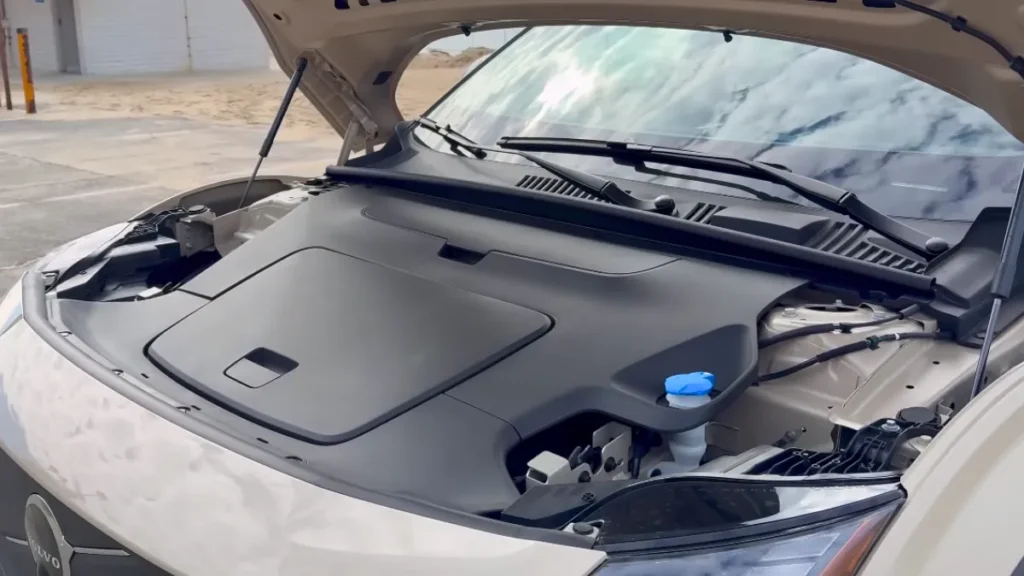
Around back, the squared-off tail design has aged better than expected. Stacked LED taillights with an illuminated Volvo script give it a presence that punches above its class. The Cross Country badge lives in the rear bumper rather than the tailgate — subtle, and actually a nice touch. The power liftgate opens to reveal 12.5 cubic feet of cargo space, which is tiny by any standard but expands to 27.8 cubic feet with seats folded. That front trunk adds a symbolic 0.25 cubic feet, with a small Easter egg graphic of a moose — because of course there is.
What the numbers don’t say about size
At 166.7 inches long and a 104.3-inch wheelbase, the EX30 is actually shorter than the old C30 hot hatch it’s meant to evoke. In a parking lot full of bloated crossovers, it looks almost impossibly small. It’s 8 to 10 inches shorter than most competitors in this segment, which creates real compromises in cargo and rear-seat space — but also makes it genuinely easy to live with in urban environments where parking is a blood sport.
Interior & Technology
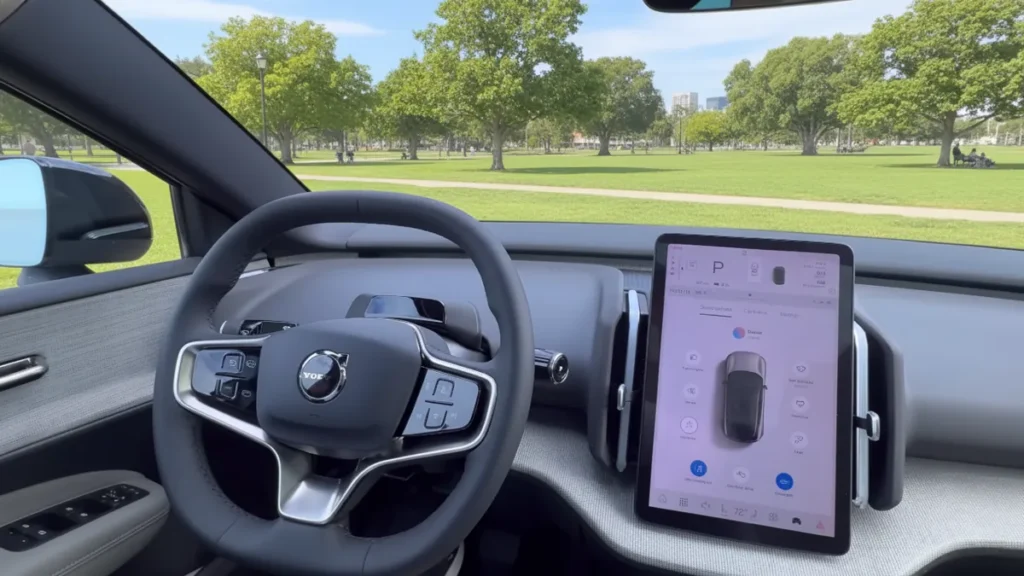
Step inside the EX30 Cross Country and you’re immediately struck by how strongly it commits to a design philosophy. The 12.4-inch portrait touchscreen dominates the center stack in the way a Tesla’s screen does — which is to say, completely. There is no instrument cluster behind the wheel. There are no physical climate controls. The steering wheel has physical buttons for volume and driver assistance functions, but that’s the extent of it. If you need to change the temperature, defrost the rear window, or access the glove box (which is, charmingly, hidden behind the touchscreen rather than in the traditional passenger-side location), you’re going through the screen.
This will be a dealbreaker for some buyers and a non-issue for others. After a week, the system becomes mostly intuitive — Google Maps is snappy and accurate, thanks to the Google built-in system, wireless Apple CarPlay and Android Auto finally arrive as standard (a long-overdue correction from early EX30 examples), and the voice recognition genuinely works for controlling climate functions without touching the screen. The camera system on the Ultra trim — the only trim available for the Cross Country — adds a full 360-degree view with excellent resolution and cross-traffic detection. It’s one of the better implementations of surround-view parking cameras in this class.
The ambiance system deserves a mention
Volvo built four themed “scenes” into the EX30 — Nordic Twilight, Forest Bath, Archipelago, Midsummer — that change the ambient lighting color scheme, display a matching background on the touchscreen, and begin playing curated music. It sounds gimmicky, and it kind of is. But sitting in Forest Bath mode in the dark, the soft green ambient lighting and the faint sound of rain coming through the Harman Kardon speakers is genuinely, unexpectedly pleasant. It’s the kind of feature that doesn’t photograph well but makes real people happy.
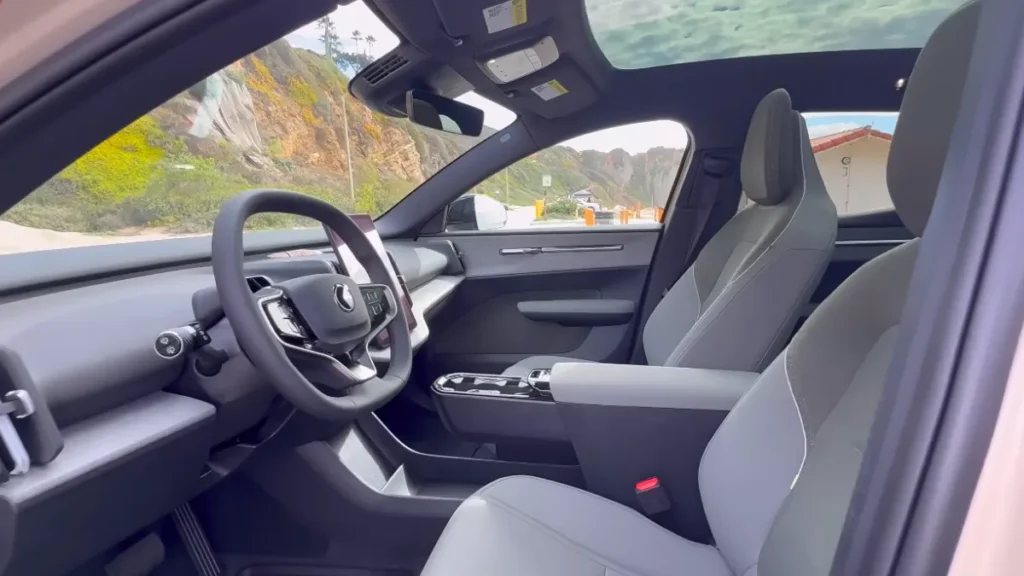
The seat material in our test car — a wool-blend and synthetic Nordico leather combination in Pixel Pine, a muted grayish-green — is one of the more distinctive upholstery choices available in this segment. Heated front seats and a 10-way power driver’s seat with memory are included. Ventilated seats are not offered, which is an omission you’ll notice in summer. No driver’s display means your speed and navigation live at the top of the 12.4-inch screen, which requires a slight right-eye shift. The driver monitoring camera mounted where the instrument cluster would normally be will beep at you aggressively when you look away — even briefly — which becomes its own minor frustration during any attempt to evaluate the cabin.
Rear seat and cargo reality check
At 5-foot-7, there’s genuinely usable legroom in the back — 32 inches by Volvo’s measurement. Headroom is good thanks to the fixed panoramic roof. But the seats don’t recline, there’s no rear armrest, and getting in and out requires some cooperation with gravity. Two USB-C ports are back there, along with a flat floor and an interesting center pass-through to the front console area. It’s the rear seat of a lifestyle vehicle, not a family hauler — and it’s worth being honest about that before signing papers.
Performance & Powertrain
The EX30 Cross Country is built on Geely’s SEA (Sustainable Experience Architecture) platform and uses a 69 kWh battery pack with approximately 64 kWh usable. Power comes from two permanent-magnet motors — 268 hp at the rear, 154 hp at the front — for a combined 422 horsepower and 400 lb-ft of torque through a single-speed reduction gear. All-wheel drive is the only configuration available on the Cross Country. Volvo quotes a 0–60 time of under 3.5 seconds, and our testing confirmed a real-world 3.41 seconds — faster than many sports cars with twice the price tag.
To put that in context: this car is quicker than a base Porsche Cayman, quicker than a stock Toyota Supra 3.0, and within spitting distance of a Chevy Corvette. In a car that’s genuinely smaller than a Volkswagen Golf GTI. The all-terrain tires and slightly elevated ride height cost roughly 0.15 seconds compared to the standard dual-motor EX30, but that’s still a genuinely remarkable performance number from a crossover you can park in spots most sedans refuse.
The platform’s near-perfect 50/50 weight distribution plays a significant role here. On a frozen river track in Montebello, the EX30 Cross Country revealed what that balance actually means in practice: even in worst-case traction conditions, power delivery is predictable, linear, and exploitable in a way most AWD vehicles at this price point simply aren’t. The low center of gravity from the underfloor battery pack means body roll is minimal despite the lifted suspension.
⚡ Powertrain at a Glance
The Cross Country’s EPA-rated range is 227 miles, according to official EPA-rated range estimates — a meaningful drop from the 253 miles in the standard dual-motor EX30, attributable to the added rolling resistance of the all-terrain tires and slightly taller ride height. In real-world testing across a week in temperatures ranging from the low 30s to the mid-40s Fahrenheit, actual range came in around 180 miles per charge. That number needs to be taken seriously by anyone considering cross-country road trips. For daily urban commuting and weekend errands, it’s workable. For a road trip through the American West or Midwest, it becomes a planning exercise.
Volvo has made no announcement about increasing battery capacity, but the case for doing so is obvious. The EX40 uses an 82 kWh pack. Even a modest increase to something in the 75 kWh range would likely push real-world range well above 220 miles and make the car dramatically more viable for longer drives. As it stands, the EX30 Cross Country is most honest when positioned as a city-centric adventure vehicle with occasional off-road ambitions — not a long-haul EV companion.
Driving Impressions
Three drive modes — Range, Standard, and Performance — are accessible through the touchscreen, and the differences are meaningful enough to bother with. In Performance mode, throttle response borders on violent. The car lunges forward with the kind of urgency that genuinely unsettles first-time passengers. Standard mode smooths things out considerably without sacrificing the car’s fundamental playfulness. Range mode reduces maximum power and softens regeneration — useful for stretching the EPA range figure in cold weather, less fun for everything else.
The steering is direct and quick, with a specificity that makes the car feel confident in corners. It’s not a feedback-rich setup — electric power steering rarely is — but the calibration prioritizes precision over communication, and on a back road with the right tires (these tires), it’s more engaging than anything this utilitarian has a right to be. The Cross Country’s softer spring tune versus the standard EX30 actually improves the driving experience for most use cases, absorbing road imperfections without the skittishness that short-wheelbase cars often suffer from at highway speeds.
One-pedal drive is available in two intensities. The high setting brings the car to a near-complete stop on lift-off — aggressive but manageable, and a useful tool for urban driving and for maximizing regenerative recovery. The low setting is more conventional, leaving a modest deceleration that still contributes to battery replenishment without making passengers reach for grab handles. Neither setting is as abrupt as GM’s one-pedal implementation in the Ultium-platform vehicles.
The ice track tells the full story
Volvo flew press out to Montebello, Quebec, to drive the EX30 Cross Country on a frozen section of the Ottawa River — three feet of ice, marked out into a handling course. The exercise was presumably designed to communicate cold-weather capability, and it succeeded. The car’s electric torque vectoring responded more predictably than an equivalent ICE AWD system, allowing for meaningful oversteer that could be caught and balanced without drama. The low center of gravity of an EV is never more apparent than when you’re asking it to corner on a surface with essentially zero friction. The EX30 Cross Country behaved like a disciplined dancing partner rather than a panicked scramble for grip.
It should be noted: running through a frozen lake at -10°C degraded the range display noticeably. Cold weather is the single biggest enemy of the EX30’s already-constrained range, and buyers in colder climates — the Pacific Northwest, the Upper Midwest, New England — should budget for meaningful real-world range reduction from November through March.
The Honest Assessment
WHAT WORKS
- Genuinely outrageous acceleration for the class and price
- Distinctive, characterful design inside and out
- Near-perfect AWD weight distribution for winter driving
- Softer cross-country suspension actually improves ride quality
- Harman Kardon audio system punches well above its weight
- Production moved to Belgium, reducing tariff exposure
- Wireless CarPlay/Android Auto finally standard
- Thoughtful details: real metal door handles, manual charge port cover, zero interior rattles
- $1,500 premium over equivalent standard EX30 Ultra is genuinely reasonable
WHAT DOESN’T
- Real-world range (~180 miles) is legitimately disappointing
- No battery upgrade option available
- $3,500 for all-terrain tires should be standard equipment
- No instrument cluster behind the steering wheel
- Driver monitoring camera is hyperactive and distracting
- Cargo volume (12.5 cu ft) is smaller than many competitors
- No ventilated seats at any trim level
- Window switches require cycling between front/rear — annoying in practice
- At $53K as tested, value proposition gets murky fast
How It Stacks Up
The Cross Country variant doesn’t exist in isolation. It competes against a growing field of compact electric crossovers, some of which have been around long enough to iron out exactly the problems the EX30 is still navigating.
| Vehicle | 0–60 mph | EPA Range | Cargo (seats up) | Starting Price | AWD? |
|---|---|---|---|---|---|
| 2026 Volvo EX30 Cross Country | 3.4s | 227 mi | 12.5 cu ft | $49,500 | Standard |
| Hyundai Ioniq 5 XRT | ~4.5s | ~266 mi | 27.2 cu ft | ~$49,900 | Standard |
| Subaru Uncharted EV | ~5.1s | ~240 mi | 18.5 cu ft | ~$43,000 | Standard |
| Mini Countryman E | ~5.6s | ~212 mi | 17.0 cu ft | ~$45,900 | Optional |
| Chevrolet Equinox EV LT AWD | ~5.9s | ~280 mi | 29.7 cu ft | ~$43,295 | Standard |
The EX30 Cross Country wins the acceleration comparison decisively — it’s roughly a second and a half faster to 60 mph than the Ioniq 5 XRT, and nearly two seconds ahead of the Subaru. But that performance gap comes at a cost: both the Hyundai and the Subaru offer meaningfully better real-world range and substantially more cargo space. The Equinox EV LT AWD is a particularly interesting competitor — it costs $6,000 less, carries more stuff, and goes further on a charge, though it gives up the EX30’s performance and virtually all of its personality.
If the Subaru Uncharted is on your shortlist, it’s worth a direct comparison. It’s slightly larger, slower, but has better range and more cargo capacity. The EX30 Cross Country wins on brand cachet, interior design quality, and raw performance. The Subaru wins on practicality and value-per-dollar. Choosing between them is genuinely a lifestyle and priority question, not a clear-cut answer.
Pricing & Value
Two years ago at the EX30’s global reveal in Milan, Volvo promised a starting price under $35,000. That number has quietly evaporated. The 2026 EX30 lineup now begins at $40,345 for the single-motor rear-drive configuration, with the dual-motor AWD adding roughly $6,000. The Cross Country is offered exclusively in the Ultra trim — there’s no base or Plus version — starting at $49,500.
EX30 Single Motor RWD
$40,345 Starting MSRP
New for 2026. Base entry point. 268 hp, up to 261 miles EPA range.
EX30 Dual Motor AWD Ultra
$48,000 MSRP
Standard EX30 top trim. 422 hp, 253 miles EPA range.
EX30 Cross Country Ultra
$49,500 MSRP
Base Cross Country model. Only about $1,500 more than the equivalent standard EX30 Ultra.
As Tested (With AT Tires)
~$53,000 As Tested
Includes $3,500 all-terrain package and destination. The number that makes you pause.
Here’s the math that actually matters: once you spec a standard EX30 in Ultra trim with the dual-motor AWD setup, the Cross Country adds only $1,500 to the bottom line. For lifted suspension, additional cladding, skid plates, and the Cross Country badge, that’s a fair deal. The problem is the optional $3,500 all-terrain tire package, which should be standard equipment on a car that markets itself as an adventure vehicle. Without it, the Cross Country has the look of an adventurer but the tires of a commuter.
As tested at $52,895 before destination, the value argument requires context. This is not a cheap car. But it’s also not straightforwardly expensive for what it is: a performance electric crossover with a real Scandinavian premium interior and industry-leading 0–60 performance in its class. The question is whether those attributes matter enough to you to accept the range limitation and the modest cargo space. For a significant portion of buyers, they will.
FINAL VERDICT
The 2026 Volvo EX30 Cross Country is a genuinely weird car in the best possible way. It’s too small for families, too expensive for budget buyers, and too slow on paper in range for road trippers. And yet it remains one of the most engaging, distinctive, and flat-out fun things you can drive in the EV segment right now.
What it gets right, it gets dramatically right. The performance is absurd. The design is coherent and committed. The interior, despite its material compromises, has a soul that most competitors in this space simply lack. The ice-track capability revealed a vehicle that takes adverse conditions seriously in a way that the spec sheet alone doesn’t communicate.
What it gets wrong is no small thing, though. A 180-mile real-world range in cold weather is a genuine limitation that will rule this car out for many buyers. And $53,000 as tested is a number that demands a hard look at the Equinox EV, the Ioniq 5, and the Subaru Uncharted before committing.
But if you live in a city, charge at home overnight, and want a car that makes you smile every single time you merge onto the freeway — the EX30 Cross Country belongs on your shortlist. It’s the spiritual heir to the C30 that Volvo fans never quite got, finally delivered. Just bring your own range expectations, and leave the cross-country road trip planning to something with a bigger battery.
FAQs About the 2026 Volvo EX30 Cross Country
The EPA-rated range is 227 miles, but real-world testing in cold weather (low 30s to mid-40s °F) returned approximately 180 miles per charge. In mild weather, expect results closer to 200–215 miles. Cold climates will push this lower. The single-motor rear-drive EX30 offers a significantly better EPA rating of 261 miles for buyers who prioritize range over AWD and performance.
Yes — and surprisingly so. The dual-motor AWD system’s near-perfect 50/50 weight distribution, combined with the electric motors’ precise torque vectoring, makes the Cross Country genuinely capable in winter conditions. Volvo conducts extensive cold-weather testing, and the car’s behavior on ice reflects that investment. Optional 235/55R18 Cooper Discoverer all-terrain tires further enhance traction on loose snow and light off-road terrain.
The Cross Country adds 0.7 inches of ground clearance (to 7.7 total), softer suspension tuning, front and rear skid plates, additional body cladding, and an available all-terrain tire package. It’s offered exclusively in the Ultra trim with the dual-motor 422 hp powertrain. The price premium over an equivalently-equipped standard EX30 Ultra is approximately $1,500 — reasonable for the hardware upgrades. The cost comes in range: the Cross Country is EPA-rated at 227 miles versus 253 for the standard dual-motor EX30.
Production of the EX30 has moved from China to Volvo’s plant in Ghent, Belgium. As of this writing, European-assembled vehicles do not qualify for the $7,500 federal EV tax credit under current IRA requirements, as outlined in the federal EV tax credit rules, which mandate North American final assembly. Buyers should verify eligibility with their dealer, as federal EV credit rules are subject to change. State and local incentives may still apply depending on your location.