

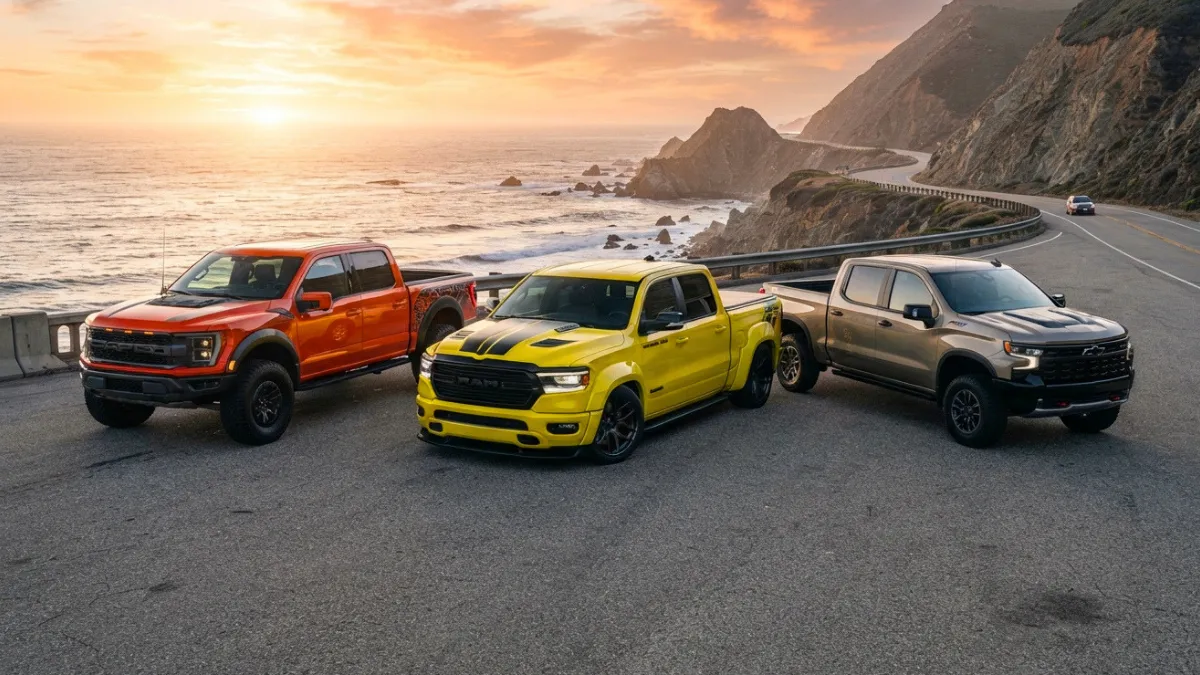
The high-performance pickup segment is undergoing a fundamental structural split. For over a decade, American truck manufacturers evaluated performance almost exclusively through an off-road lens. To earn a flagship performance badge, a full-size pickup required long-travel suspension, widened fender flares, beadlock-capable wheels, and internal bypass dampers capable of absorbing high-velocity impacts across desert washouts.
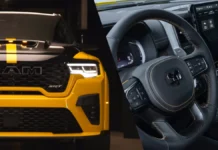
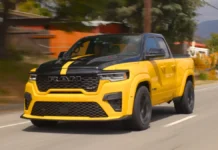
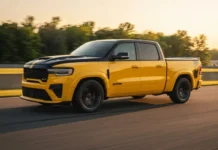
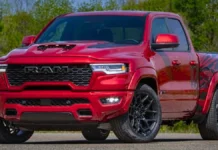
However, while Ford and Chevrolet continue refining their desert-runner recipes, Ram has pivoted hard back toward muscle car heritage with the launch of the 2027 Ram 1500 Rumble Bee family. Built on a shrunken wheelbase with a unique Quad Cab short-bed configuration, this truck targets an entirely different mechanical mission: street supremacy.
While enthusiast forums frequently cross-shop the Rumble Bee against the Ford F-150 Raptor and Chevrolet Silverado ZR2 due to their shared price tiers and elevated output numbers, comparing these three trucks requires understanding their radically divergent chassis engineering, powertrain delivery, and aerodynamic dynamics. For a complete breakdown of Ram’s engine options, check our guide on 2027 Ram 1500 Rumble Bee Engine Specs.
Architectural Intent: Street Performance vs. Off-Road Endurance
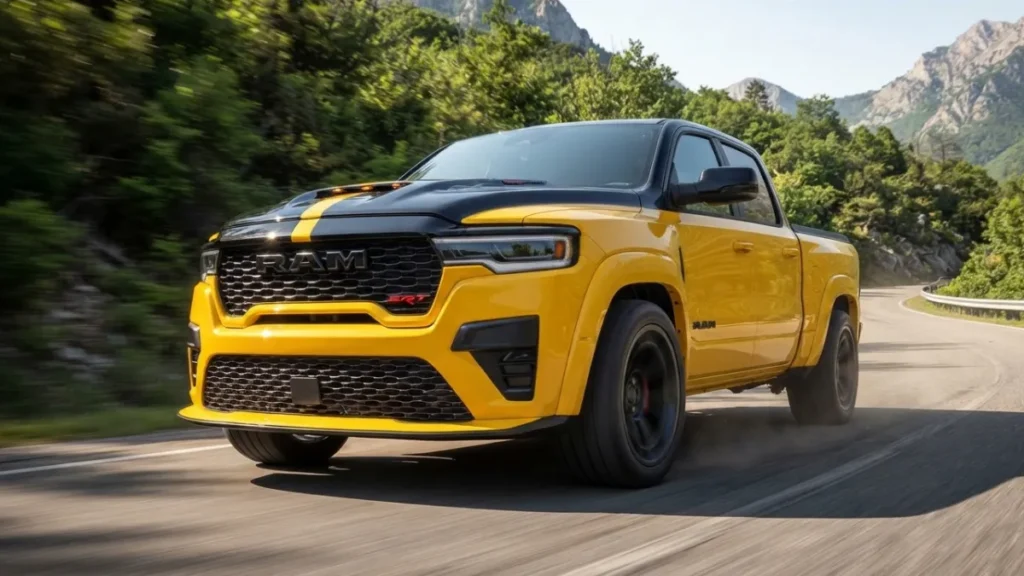
Comparing the 2027 Ram 1500 Rumble Bee directly to the Ford F-150 Raptor or Chevy Silverado ZR2 solely on peak horsepower output ignores the fundamental engineering tradeoffs built into their respective suspension architectures.
Suspension Geometry and Damping Tech
The Ford F-150 Raptor and Chevrolet Silverado ZR2 are engineered around maximum suspension travel and impact energy dissipation:
- Ford F-150 Raptor: Features a five-link rear suspension setup paired with Fox Live Valve internal bypass dampers. These electronically controlled shocks continuously adjust compression damping based on wheel position, providing roughly 13 inches of front wheel travel and 14.1 inches out back.
- Chevrolet Silverado ZR2: Utilizes Multimatic DSSV (Dynamic Suspensions Spool Valve) dampers, a technology derived from endurance sports car racing. Instead of traditional shim stacks, the DSSV units employ precise spool valves for temperature-insensitive damping curves.
While these suspension setups excel at high-speed desert running and technical trail crawling, high ground clearance raises the center of gravity. Long-travel, soft-rate springs inherently introduce body roll, nose-dive under heavy braking, and squat during hard acceleration.
In contrast, the 2027 Ram 1500 Rumble Bee prioritizes lateral stability, instantaneous turn-in response, and low-speed pavement traction:
- Shortened Wheelbase Chassis: Ram engineers removed 13 inches of frame between the axles, creating a tight Quad Cab and 5’7″ short-bed geometry optimized for rapid directional changes.
- Street-Calibrated Suspension: Depending on the trim, the Rumble Bee utilizes lower-slung coil setups with custom Bilstein dampers or active electronic suspension tuned specifically to minimize body roll through high-g cornering.
- Low Roll Center: Stiffer sway bars and wider track panels borrowed from the RHO preserve the tire contact patch under severe lateral acceleration.
Engineering Fact: High-travel off-road suspensions transfer weight slowly, hurting 0-60 mph launch consistency on asphalt. The Rumble Bee’s low ride height and rigid spring rates enable maximum torque transfer off the line without tire hop.
Powertrain Benchmarking: EcoBoost V6 vs. EcoTec V8 vs. HEMI Lineup
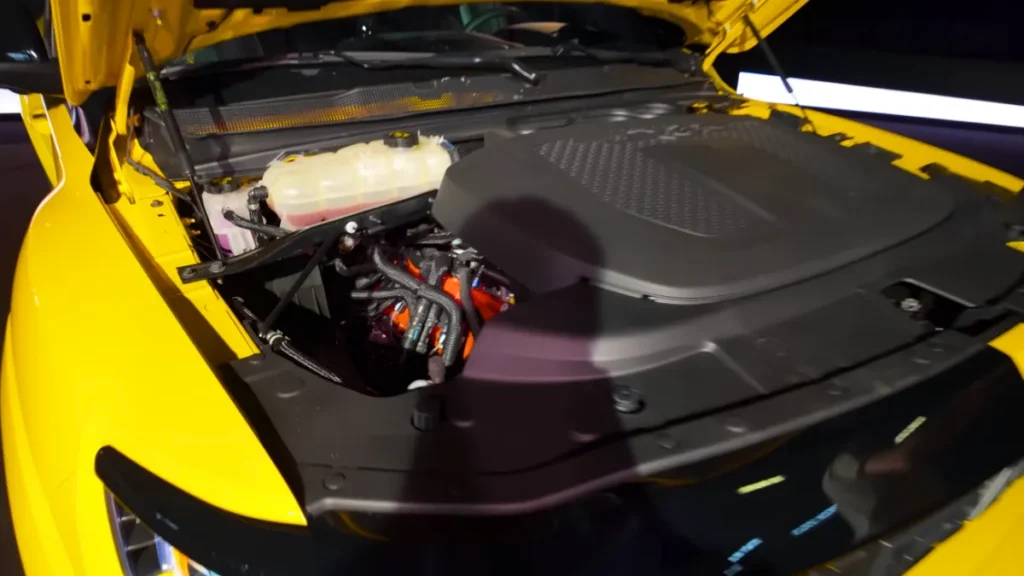
Under the hood, all three manufacturers take wildly different mechanical paths to power output. While Ford relies on twin-turbocharged displacement efficiency and Chevy stays true to a naturally aspirated big-block V8, Ram brings back iconic HEMI V8 firepower across a tiered trim strategy.
| Specification | Ford F-150 Raptor | Chevy Silverado ZR2 | Ram 1500 Rumble Bee (Base / SRT) |
|---|---|---|---|
| Engine Type | 3.5L High-Output EcoBoost V6 | 6.2L EcoTec3 L87 V8 | 5.7L / 6.4L / Supercharged 6.2L HEMI V8 |
| Aspiration | Twin Turbochargers | Naturally Aspirated | Naturally Aspirated / Twin-Screw Supercharged |
| Horsepower | 450 hp @ 5,850 RPM | 420 hp @ 5,600 RPM | 395 hp – 777 hp |
| Torque (lb-ft) | 510 lb-ft @ 3,000 RPM | 460 lb-ft @ 4,100 RPM | 410 lb-ft – 680 lb-ft |
| Transmission | 10-Speed Automatic | 10-Speed Automatic | 8-Speed TorqueFlite Automatic |
| Core Mission | High-Speed Desert Running | Technical Rock & Trail Hybrid | Straight-Line Street & Track Muscle |
Engine Dynamics and Tuning Philosophy
According to engine analysis from the Society of Automotive Engineers (SAE), displacement and forced induction dictate distinct power delivery curves:
1. Ram 1500 Rumble Bee Family: Ram offers three distinct V8s. The base model features the 395-hp 5.7L HEMI V8 (“Eagle”). Stepping up to the 392 model nets a naturally aspirated 6.4L HEMI V8 making 470 hp. The flagship Rumble Bee SRT drops in a 2.4L twin-screw supercharged 6.2L Hellcat V8 delivering 777 horsepower and 680 lb-ft of torque.
2. Ford 3.5L EcoBoost V6: Delivers early low-end torque (510 lb-ft at 3,000 RPM) optimal for overcoming trail obstacles, though peak power flattens out near redline compared to high-displacement V8 options.
3. Chevy 6.2L L87 V8: Provides classic linear acceleration with instant throttle response. However, at 420 hp, it lacks the raw straight-line surge of forced-induction competitors.
Real-World Performance Metrics: Telemetry Breakdown
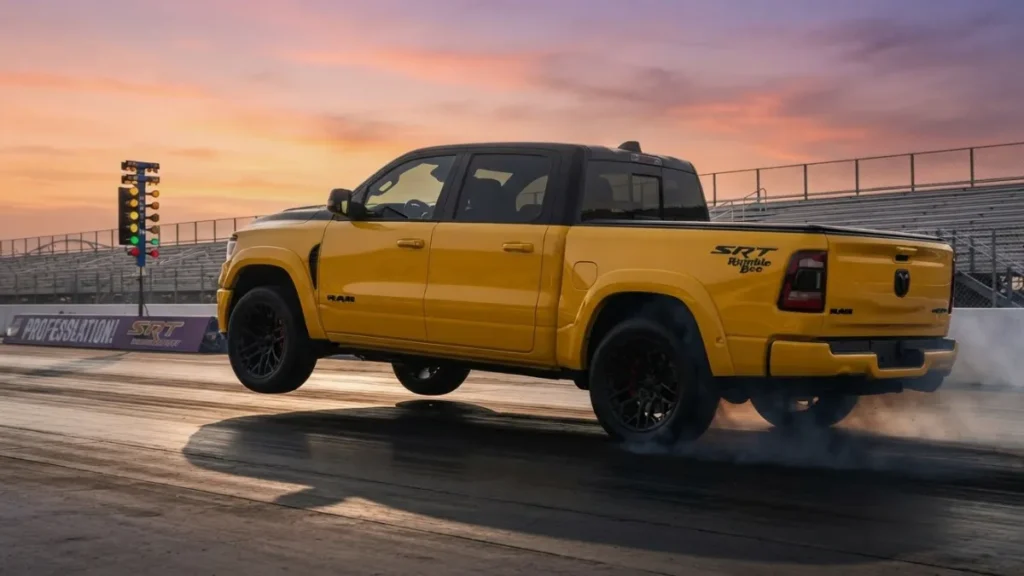
When evaluated on tarmac performance, the combination of road-tuned rubber, short gear ratios, and low center of gravity gives the street truck a massive advantage in straight-line times and cornering grip.
| Metric | Ford F-150 Raptor | Chevy Silverado ZR2 | Ram Rumble Bee SRT (777 HP) |
|---|---|---|---|
| 0–60 mph Acceleration | 5.2 seconds | 5.7 seconds | 3.4 seconds |
| Standing 1/4-Mile | 13.9 @ 98 mph | 14.2 @ 97 mph | 11.6 @ 116 mph |
| Top Speed | 120 mph (governed) | 112 mph (governed) | 170 mph |
| Primary Rubber | 35″ All-Terrain Tires | 33″ Mud-Terrain Tires | 22″ High-Performance Street Tires |
Braking and Transmission Control
Stopping a 5,500-pound truck under track conditions demands significant thermal mass. While the Raptor and ZR2 rely on smaller brake assemblies to clear 17-inch off-road wheels, the Rumble Bee fits class-leading large brake rotors inside 22-inch aluminum wheels. Testing data from outlets like MotorTrend and Car and Driver highlights that street-compound rubber drastically reduces 70-0 mph stopping distances compared to knobby off-road treads.
Target Buyer Profile: Which Truck Fits Your Driveway?
Understanding vehicle intent makes buyer selection straightforward:
The Desert & Trail Enthusiast (Raptor / ZR2): Prioritizes 12+ inches of ground clearance, high approach angles, and long-travel bump absorption for high-speed sand running or technical trail crawling. Daily road comfort is secondary to off-road durability.
The Street & Muscle Truck Enthusiast (Rumble Bee): Views their truck as an everyday performance vehicle capable of embarrassing sports cars at drag strips, delivering an aggressive exhaust growl, and cornering flat without sacrificing practical bed utility.
Pricing dynamics also dictate selection. As analyzed in our main 2027 Ram 1500 Rumble Bee guide, street trucks avoid expensive long-travel bypass shocks, making base V8 models highly accessible while the flagship SRT claims absolute speed dominance.
The Verdict
None of these trucks are inherently “better”—they solve entirely different problems. Ford and Chevy continue to perfect the long-travel off-road vehicle. Meanwhile, Ram has re-established the factory muscle street truck lane with the 2027 Rumble Bee.
If your weekends involve rocky trails and sand dunes, stick with the Raptor or ZR2. But if you want a machine that launches hard, carves canyon roads with confidence, and brings pure V8 rumble back to pavement, the Ram Rumble Bee stands alone in today’s market.