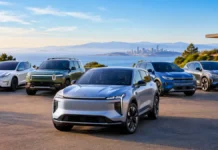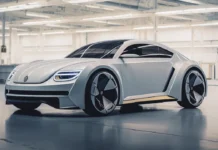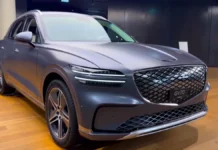
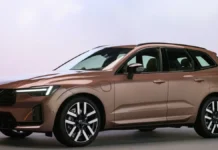


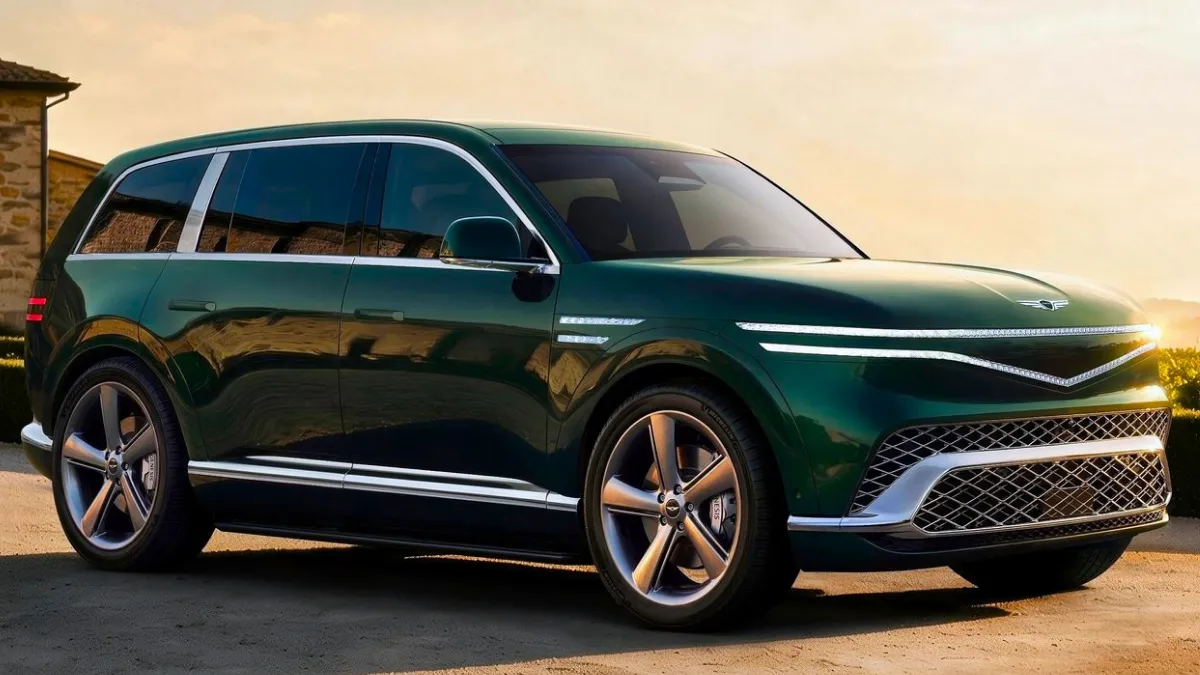
The 2028 Genesis GV90 marks the Korean brand’s boldest entry into the full-size electric luxury segment. Serving as Genesis’s first three-row flagship EV, this massive SUV aims directly at the upper crust of the market—targeting established rivals like the Mercedes-Maybach EQS SUV and Range Rover EV. Built on Hyundai Motor Group’s dedicated next-generation eM platform, the GV90 packs dual electric motors delivering up to an estimated 657 horsepower, a massive 123.5-kWh battery pack targeting around 316 miles of range, multi-chamber air suspension, and available rear-wheel steering.
Rather than simply stretching the existing GV80 gas-powered platform, Genesis developed the GV90 from the ground up as a dedicated electric showcase. It borrows heavily from the striking Neolun concept, translating those smooth, monolithic proportions into a production flagship. Beyond its silent dual-motor powertrain, the GV90 focuses heavily on a chauffeur-grade cabin experience. Inside, you’ll find three rows of seating, a colossal pillar-to-pillar OLED display, multi-zone massaging seats, and four-zone climate control. While standard models will use conventional doors, Genesis is also hinting at an ultra-exclusive version featuring the Neolun’s signature B-pillarless coach doors.
With available 24-inch forged wheels and an uncompromising emphasis on rear-seat comfort, the GV90 signals that Genesis is no longer content with being a value-oriented alternative in the luxury sphere—it wants to set the standard.
Contents
- Why the Genesis GV90 Matters
- Exterior Design
- Powertrain and Performance
- Battery, Range, and 800V Fast Charging
- Interior & Technology: A First-Class Sanctuary
- The Neolun Variant: Coach Doors, Seats, and Safety
- Ride Dynamics and Chassis Engineering
- GV90 vs. GV80
- How the Genesis GV90 Compares to Rivals
- Pricing Expectations and Market Positioning
- Release Date and Market Availability
- GV90 Fact Sheet
- Final Verdict
- Frequently Asked Questions
Why the Genesis GV90 Matters
A decade ago, Genesis could satisfy buyers simply by offering a polished, value-oriented alternative to midsize mainstays like the BMW X5 or Mercedes-Benz GLE. That baseline is no longer enough. The top tier of the luxury SUV market has evolved into an arena dominated by full-size, six-figure EVs packed with first-class rear seating, ultra-quiet powertrains, and lounge-like interior technology. The GV90 steps directly into a competitive field that includes heavyweights like the Cadillac Escalade IQ, Mercedes-Maybach EQS SUV, and Range Rover EV.
Rather than attempting to copy European or American luxury tropes, Genesis distinguishes the GV90 through its traditional ethos of Korean hospitality (Son-nim). Instead of treating the interior purely as an automotive cabin, designers structured the space like a modern residential lounge. This concept centers on seamless ambient heating, warm material integration, and an uncluttered visual environment. While the smaller GV80 established Genesis as a legitimate luxury player, the GV90 serves a distinct strategic purpose: proving whether the brand can successfully convince buyers to spend well over $100,000 on a flagship Korean vehicle.
Exterior Design
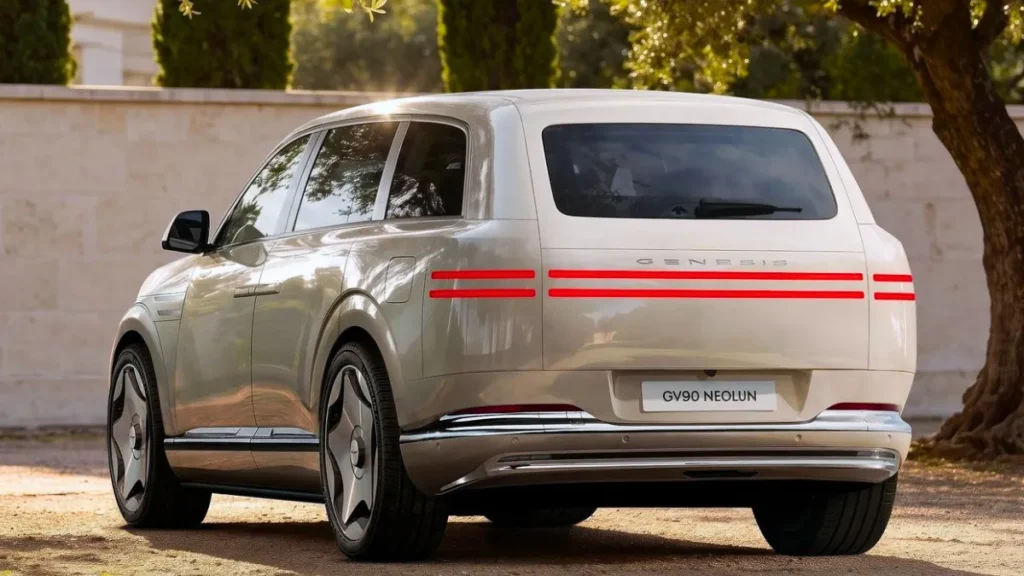
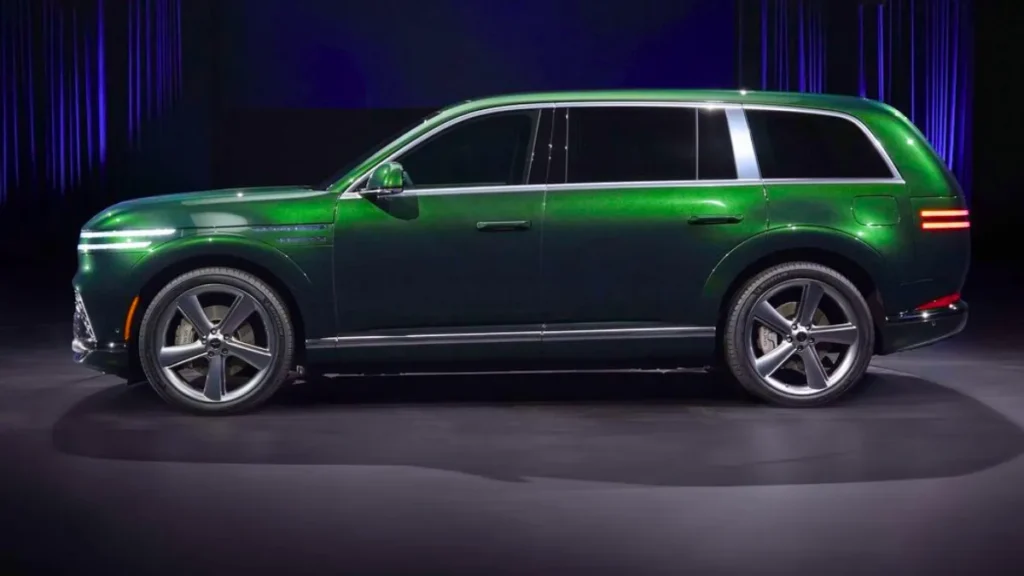
Visually, the GV90 imposes itself through sheer scale and minimalist surfacing. Measuring 208.1 inches (5,285 mm) in overall length with a generous 127.8-inch (3,245 mm) wheelbase, Genesis has provided enough structural floorplan to accommodate a legitimate three-row layout rather than squeezing temporary jump seats behind the second row. Instead of relying on aggressive body creases or heavy plastic cladding, the design draws heavily from the monolithic Neolun concept—favoring clean, uninterrupted body panels and an upright, dignified profile.
Up front, the absence of an internal combustion engine eliminates the need for a massive traditional grille. Genesis fills that real estate with its signature lighting identity: slenders, jewel-like Multi-Lens Array (MLA) headlights paired with a seamless two-line LED motif that extends smoothly into the front fenders. By avoiding non-functional fake air vents and overly busy ornamental trim, the front fascia maintains a calm, confident look that reads as undeniably high-end.
Filling those massive wheel arches are available 24-inch forged alloy wheels, particularly on upper-tier trim specifications. Mounting 24-inch wheels on a heavy luxury SUV often threatens ride comfort, but Genesis offsets this with an advanced multi-chamber air suspension system equipped with adaptive dampers. The setup dynamically isolates cabin occupants from road imperfections while keeping body roll strictly under control during cornering. Maneuverability is further enhanced by rear-wheel steering capable of pivoting up to five degrees, drastically tightening the turning radius and keeping this 208-inch flagship manageable in tight urban parking structures.
Powertrain and Performance
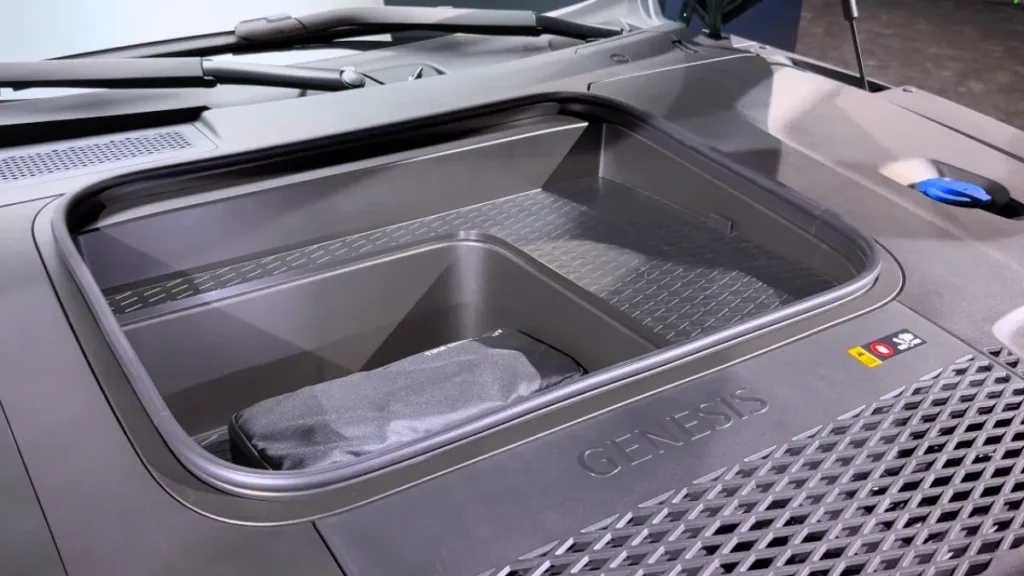
Genesis engineered the GV90 to deliver effortless acceleration rather than razor-sharp track performance. Power comes from a heavy-duty dual-motor all-wheel-drive setup producing a combined 490 kW—equivalent to 657 horsepower—and 590 lb-ft (800 Nm) of torque. The output is split between a 240 kW front motor and a 250 kW rear unit, giving the rear axle a slight power bias for improved dynamics under hard acceleration.
GV90 Performance Specifications at a Glance:
- Total Power Output: 657 hp (490 kW)
- Total Torque: 590 lb-ft (800 Nm)
- Drivetrain: Dual-motor All-Wheel Drive with front & rear e-LSDs
- Acceleration (0–60 mph): Estimated 4.9 seconds
- Chassis Hardware: Multi-chamber air suspension & rear-wheel steering (up to 5°)
Because full torque is available instantly without waiting for turbochargers to spool or a transmission to downshift, the GV90 moves its massive footprint with surprising urgency. Genesis estimates a 0–60 mph sprint of under five seconds. While that figure won’t rival dedicated electric super-sedans, it provides more than enough pass-at-will power for a three-row flagship tasked with carrying families and luggage in near silence.
Dual E-LSDs: Advanced Torque Vectoring
Beyond straight-line acceleration figures, one of the GV90’s most compelling engineering highlights is its dual electronic limited-slip differential setup. The flagship SUV marks the first Hyundai Motor Group application to deploy active E-LSDs across both the front and rear axles simultaneously. By actively metering power across all four wheels, the dual-differential setup optimizes traction during hard cornering and mitigates wheelspin on low-friction road surfaces.
When combined with the five-degree rear-wheel steering system and adaptive air suspension, this chassis hardware provides the structural capability to make the massive three-row SUV feel surprisingly planted. However, while Genesis’s technical specifications look strong on paper, definitive conclusions regarding skidpad lateral grip, braking distances, and real-world handling agility must wait until full instrumented track testing of US-spec production models takes place.
Battery, Range, and 800V Fast Charging
To propel a vehicle of this scale, Genesis equipped the GV90 with a massive 123.5-kWh battery pack—the largest capacity ever deployed by Hyundai Motor Group. Genesis estimates an operational driving range of up to 316 miles (approx. 500 km) on a single charge. While a 300-plus-mile rating is respectable for a heavy, dual-motor flagship, it is not class-leading on paper; certain rivals push toward higher figures. However, raw range wasn’t the sole engineering focus—the massive battery must also support a high-draw 657-horsepower output and an elaborate array of active cabin electronics.
Where Genesis compensates for moderate efficiency is in charging performance. Built on an advanced high-voltage architecture, the GV90 supports 350-kW DC fast charging. Plugged into a compatible ultra-rapid charger, the 123.5-kWh battery can replenish from 10 to 80 percent in approximately 22 minutes. By prioritizing rapid energy replenishment over an oversized, overly heavy battery footprint, the GV90 balances long-distance usability with real-world luxury convenience.
800-Volt Architecture and Native NACS Integration
The core advantage of Genesis’s EV architecture lies in its high-voltage flexibility. Equipped with an 800-volt system capable of accepting up to 350 kW at DC fast-charging stations, the GV90 can replenish its 123.5-kWh battery from 10 to 80 percent in roughly 22 minutes under ideal thermal conditions. Because a large battery’s real-world charging curve naturally tapers as the state of charge rises, sustaining high kilowatt rates early in the session is critical for minimizing highway downtime.
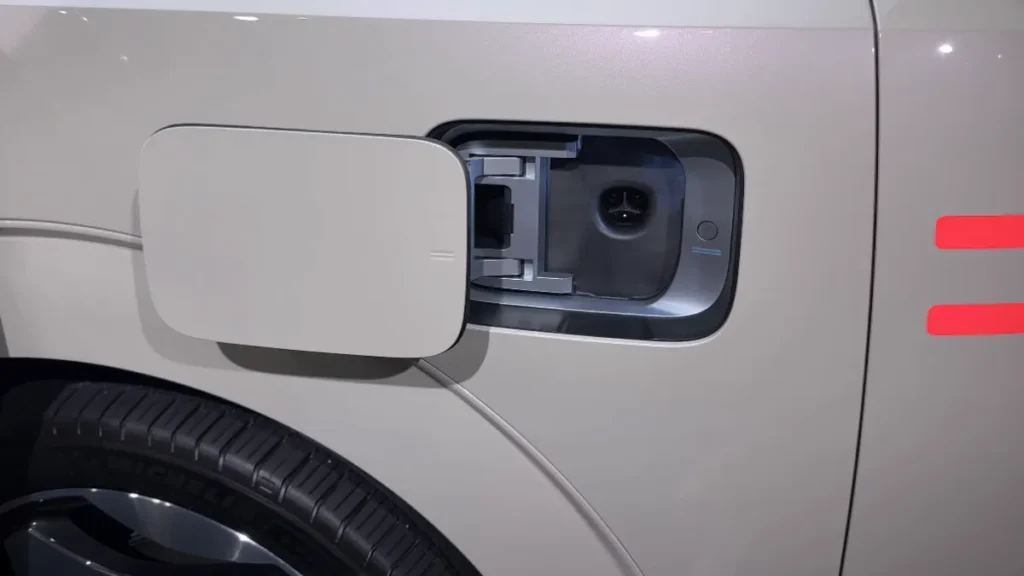
For North American buyers, practical usability is significantly boosted by a native NACS (North American Charging Standard) port. By adopting the NACS connector directly from the factory, the GV90 gains seamless, plug-and-play access to the vast Tesla Supercharger network alongside existing 800V CCS infrastructure via adapters. For a flagship luxury vehicle intended for long-distance highway cruising, this dual-network compatibility removes one of the largest friction points in large-capacity EV ownership.
Interior & Technology: A First-Class Sanctuary
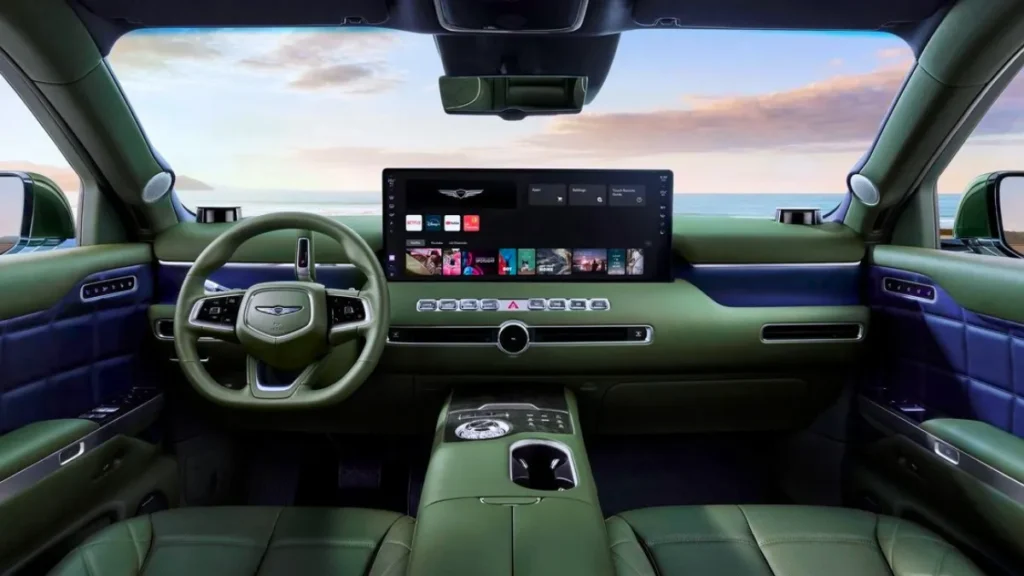
While the exterior design makes a strong first impression, the cabin is where the GV90 presents its most compelling argument. Designed around an opulent lounge concept, the interior balances high-end tactile materials—such as supple Nappa leather, open-pore genuine wood trim, and tailored woven textiles—with flexible seating configurations. Depending on buyer requirements, the GV90 can be optioned as a practical 6- or 7-passenger family cruiser, a 5-seat layout, or an ultra-exclusive 4-seat Neolun executive suite equipped with rear captain’s chairs and an integrated center console.
The technological focal point is Genesis’s innovative motor-driven OLED Cinematic Display. During active driving, the screen maintains a low profile at 23.6 inches to preserve forward visibility. When parked or set to entertainment mode, a silent mechanical actuator elevates the panel by 90 millimeters, expanding the viewable area to a 24.6-inch presentation. This adjustable mechanism delivers a massive widescreen experience without creating an intrusive dashboard obstruction. Driver orientation is further enhanced by a massive 25-inch Head-Up Display (HUD), which projects vital telemetry, navigation, and driver-assist graphics directly onto the windshield.
Software Ecosystem and Cabin Ambience
On the software front, the GV90 debuts Genesis’s upgraded digital architecture, powered by the Pleos Connect operating environment. This system seamlessly unifies navigation, media streaming, third-party applications, and vehicle settings over-the-air. To elevate cabin atmosphere, the interface incorporates customizable multisensory routines. At the touch of a button, these automated presets simultaneously adjust ambient LED lighting, internal fragrance dispensers, seat massage programs, climate control, and audio soundscapes—creating an intuitive, tailored sanctuary that minimizes driver menu navigation.
Seating Comfort and Passenger Accommodation
In the high-end three-row segment, mechanical specs mean little if the rear passenger quarters feel compromised. Exploiting its long 127.8-inch wheelbase and flat skateboard EV architecture, Genesis maximizes usable interior volume across all three rows. Second-row buyers can select power-adjustable executive captain’s chairs equipped with heating, ventilation, and massage functions, while third-row occupants benefit from generous legroom rather than standard jump-seat proportions.
Thermal comfort is managed by a comprehensive four-zone automatic climate control system featuring independent digital controls and targeted air vents for each seating row. Complementing the HVAC setup are innovative radiant heating surfaces integrated into the door panels, armrests, and lower dash—a feature designed to warm passenger limbs directly while minimizing the energy draw of high-velocity blower fans.
Third-Row Packaging: A True Full-Size SUV
While the midsize GV80’s optional third row was notoriously cramped and suited primarily for small children, the GV90 addresses that packaging deficit directly. Thanks to its dedicated EV platform, extended rear overhang, and 127.8-inch wheelbase, the cabin provides adult-friendly legroom and headroom in the rearmost seats. Rather than treating the third row as an emergency afterthought, Genesis engineered the GV90 from the ground up as a legitimate full-size three-row flagship capable of long-distance family travel.
The Neolun Variant: Coach Doors, Seats, and Safety
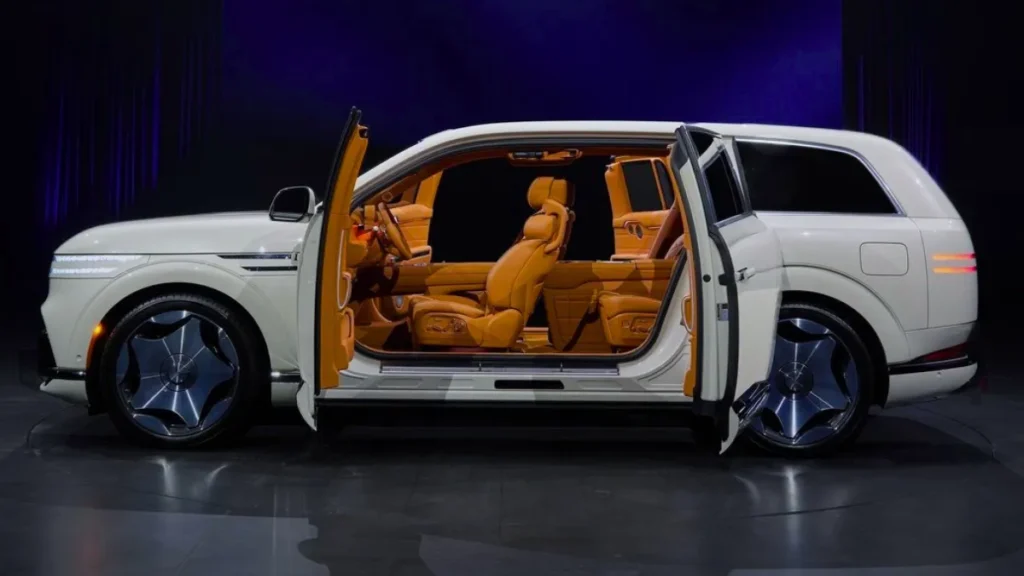
The most distinctive iteration of the lineup is the ultra-luxury Neolun edition, which incorporates Genesis’s “Arch Gate” coach-door system. By integrating a reinforced, hidden B-pillar directly into the door assemblies, opening both side doors creates an unobstructed, pillarless entry aperture. To complete the executive lounge environment, the front seats can swivel 180 degrees while parked, allowing front occupants to face second-row passengers across an integrated floor console.
Eliminating a conventional central B-pillar raises immediate structural safety questions, but Genesis addresses this with a high-strength aluminum framework, an integrated roll-cage architecture, and a total of 12 airbags. Chief among these safety features is a world-first roof-mounted airbag designed to deploy downward across the glass roof area during a rollover event, preserving structural cabin integrity and protecting passenger headroom.
Standard and Available Luxury Equipment
To justify its flagship status, Genesis equips the GV90 with a comprehensive suite of comfort, acoustic, and chassis technologies as standard or available features. Rather than burying essential luxury hardware behind expensive option packages, the platform integrates high-end appointments across all three rows.
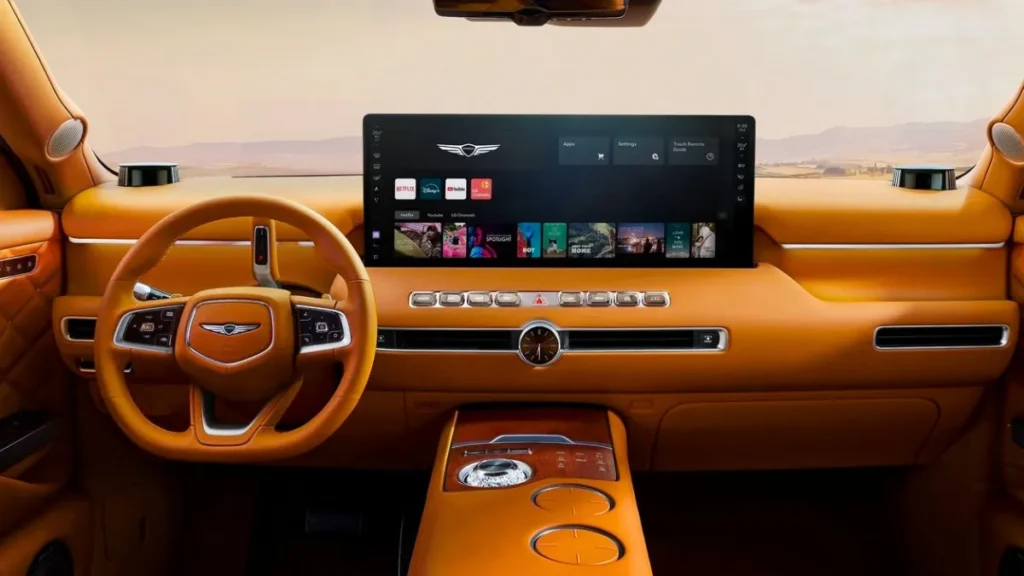
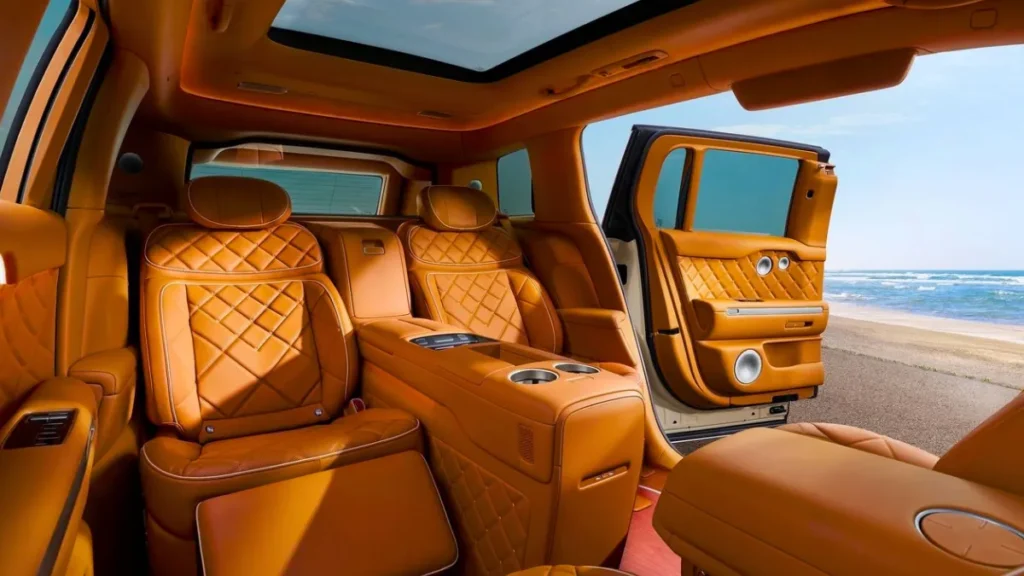
- Cabin Acoustics & Audio: Premium Bang & Olufsen 3D Surround Sound system paired with active road noise cancellation technology.
- Seating & Comfort: Nappa leather upholstery, open-pore wood trim, front and second-row massaging seats with heating and ventilation, and four-zone climate control.
- Digital Displays: 24.6-inch motorized OLED Cinematic Display, 25-inch Head-Up Display (HUD), and Pleos Connect software with 5 customizable cabin Routines.
- Chassis & Maneuverability: Multi-chamber air suspension with preview road scanning, 5-degree rear-wheel steering, and Remote Smart Parking Assist.
- Neolun Exclusive Highlights: Integrated Arch Gate coach doors, 180-degree swiveling front seats, and radiant panel heating.
By packaging these high-end materials alongside advanced driver-assistance hardware, Genesis ensures the GV90 competes directly with established European rivals on feature density rather than relying solely on price positioning.
Want to learn more about modern automotive tech?
Check our in-depth breakdown of infotainment, safety features, and driver assistance in our Car Technology Guide.
Ride Dynamics and Chassis Engineering
In the ultra-luxury EV segment, straight-line power is relatively easy to achieve; managing a curb weight approaching 6,000 pounds through corners is where true chassis engineering shows. To prevent the 208-inch GV90 from feeling floaty or unwieldy, Genesis integrated an interconnected suite of chassis controls: multi-chamber air suspension, road-preview adaptive dampers, dual active E-LSDs, and a 5-degree rear-wheel steering system.
The rear-wheel steering system plays a dual role in masking the vehicle’s physical footprint. At low speeds, the rear wheels counter-steer against the front axle to drastically tighten the turning circle in tight maneuvers. At highway speeds, the rear wheels steer in phase with the front, enhancing high-speed lane-change stability and directional composure. While final dynamic judgment must wait for independent instrumented road tests, this hardware suite provides the GV90 with the necessary mechanical foundation to balance high-speed comfort with composed body control.
GV90 vs. GV80
While the midsize GV80 served as Genesis’s initial entry into the luxury SUV segment, the GV90 occupies a distinctly higher flagship tier. The GV90 does not replace the GV80; rather, it sits above it as a technology halo vehicle, offering significantly larger dimensions, an exclusive dedicated EV architecture, and ultra-luxury seating options unavailable on the midsize model.
| Feature | Genesis GV80 | Genesis GV90 |
|---|---|---|
| Vehicle Segment | Midsize Luxury SUV | Full-Size Flagship Luxury SUV |
| Powertrain | Gasoline (Turbo V6 / I4) & EV options | All-Electric Dual-Motor AWD |
| Maximum Output | Up to 375 hp | 657 hp (490 kW) |
| Battery Capacity | 77.4 kWh (Electrified GV70/GV80 variants) | 123.5 kWh |
| Wheelbase | 116.3 inches (2,955 mm) | 127.8 inches (3,245 mm) |
| Third-Row Usability | Compact / Emergency use | Adult-friendly Full-Size Space |
| Chassis Tech | Adaptive Suspension (Preview ECS) | Multi-Chamber Air Suspension + Rear Steering (5°) |
| Exclusive Features | Standard Doors / Conventional Display | Available Coach Doors, 180° Seats & Motorized OLED |
For existing Genesis owners, the GV90 represents a logical upgrade path for those requiring legitimate three-row passenger volume, ultra-fast 800V DC charging, and the highest level of executive comfort Genesis has produced to date.
How the Genesis GV90 Compares to Rivals
Genesis GV90 vs. Cadillac Escalade IQ: Clash of Luxury Philosophies
In the North American market, the Cadillac Escalade IQ stands out as one of the GV90’s most direct full-size electric competitors. Both flagships target the same high-net-worth buyers requiring full three-row passenger volume, ultra-high power outputs, and expansive digital displays. However, they approach electric luxury from vastly different design perspectives.
The Escalade IQ leans heavily into traditional American luxury with imposing exterior proportions, an expansive 55-inch pillar-to-pillar screen, and a massive battery footprint. In contrast, the GV90 presents a more architectural, monolithic aesthetic inspired by the Neolun concept. While Cadillac emphasizes commanding road presence and established brand heritage, Genesis distinguishes itself through interior modularity—offering available coach doors, 180-degree swiveling seats, and an ultra-exclusive four-passenger executive suite. This contrast gives buyers a clear choice between bold American scale and sophisticated Asian minimalism.
Genesis GV90 vs. Range Rover Electric: Prestige vs. EV Innovation
The Range Rover remains the global benchmark for flagship SUV prestige, combining decades of heritage with unmatched off-road capability. Rather than attempting to copy Land Rover’s traditional playbook, Genesis positions the GV90 as a forward-looking alternative centered around advanced EV engineering, Korean aesthetic minimalism, and passenger hospitality.
While Range Rover retains a clear advantage in brand equity and all-terrain pedigree, the GV90 counters with a purpose-built 800V EV architecture, rapid 350-kW charging, and innovative cabin features like motorized OLED displays and available coach doors. For traditional buyers prioritizing legacy prestige, Range Rover remains a formidable choice; however, for tech-focused drivers seeking a modern luxury sanctuary without combustion-platform compromises, the GV90 presents a highly persuasive alternative.
Genesis GV90 Neolun vs. Mercedes-Maybach GLS: The Ultra-Luxury Benchmark
While standard configurations of the GV90 target high-end family transport, the top-tier Neolun edition moves directly into ultra-luxury territory occupied by the Mercedes-Maybach GLS. By incorporating rear-hinged coach doors, 180-degree swiveling seats, and a dedicated four-passenger lounge configuration, Genesis openly challenges established ultra-luxury brands for executive chauffeur duties.
Genesis lacks the century-old prestige associated with the Maybach badge, but the GV90 counters with a fully electric skateboard architecture that enables a completely flat cabin floor and unmatched spatial modularity. Rather than dressing up a conventional combustion chassis with chrome trim and extra padding, Genesis leverages silent EV propulsion, radiant heating, and cinematic display tech to deliver a modern lounge experience that feels distinctly futuristic compared to legacy competitors.
Pricing Expectations and Market Positioning
While Genesis has confirmed the GV90 as a 2028 model arriving in early 2027, official U.S. MSRP pricing remains undisclosed. However, examining current lineup economics provides a realistic baseline for market positioning. With the flagship G90 sedan currently starting at $92,700 and stretching beyond six figures in top-tier trims, the larger GV90—with its 123.5-kWh battery, 800V charging architecture, and multi-chamber air suspension—will almost certainly launch in the $100,000 to $115,000 range for base trim levels.
Specifying the top-tier Neolun edition with its motorized OLED displays, swiveling front seats, radiant panel heating, and hidden B-pillar coach doors will push the vehicle well beyond standard flagship pricing. Industry projections suggest fully optioned Neolun variants could approach or exceed the $150,000 mark—positioning it as an accessible alternative to $200,000-plus ultra-luxury offerings like the Mercedes-Maybach GLS. Definitive numbers, however, will only be finalized closer to its official market launch.
Release Date and Market Availability
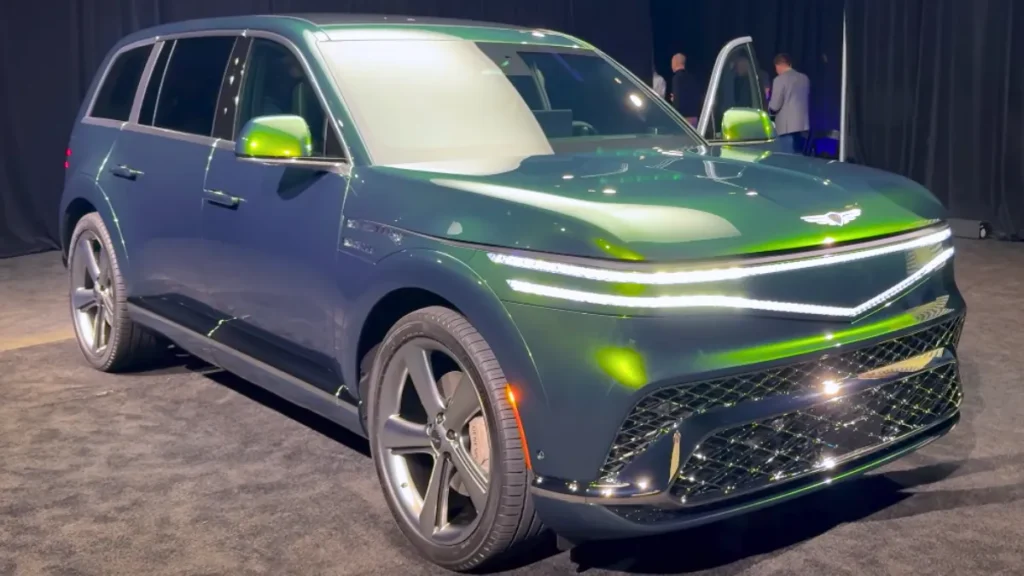
Genesis has officially designated the GV90 as a 2028 model year vehicle, with North American customer deliveries scheduled to begin in early 2027. Following its global debut, the vehicle currently serves as a flagship halo preview on Genesis’s consumer platforms while pre-production testing and regional homologation are completed. As the brand prepares its retail network for its most expensive vehicle to date, final U.S. equipment packaging, software refinements, and official EPA range ratings will be finalized closer to its 2027 commercial rollout.
For more automotive buying advice:
Browse all of our official Car Buyer’s Guides.
GV90 Fact Sheet
As Genesis prepares its flagship for production, separating factory-validated specifications from pending U.S. market details is essential for prospective buyers. Below is a breakdown of what has been officially confirmed versus what remains to be verified closer to launch.
Confirmed Technical Specifications:
- Target Launch: Early 2027 U.S. arrival (2028 Model Year)
- Drivetrain: Dual-motor AWD producing up to 657 hp & 590 lb-ft (800 Nm)
- Battery & Range: 123.5-kWh capacity; estimated up to 316 miles
- Charging: 800V architecture (350 kW DC max; 10–80% in ~22 min)
- Chassis Hardware: Multi-chamber air suspension & 5° rear-wheel steering
- Cockpit Tech: 23.6″/24.6″ motorized OLED display + 25″ HUD
- Neolun Edition: Hidden B-pillar coach doors & 180° swiveling seats
- Safety Hardware: 12 airbags including world-first roof airbag
Pending Official Confirmation:
- Official U.S. MSRP & option pricing breakdown
- Official EPA-certified electric range ratings
- Final U.S. curb weight and gross vehicle weight ratings
- Official 0–60 mph and quarter-mile instrumented test results
- Maximum towing capacity ratings
- Exact cargo volume measurements behind 2nd and 3rd rows
- Trim-level equipment matrix for North American models
official EPA-certified electric range ratings
Final Verdict
The 2028 Genesis GV90 marks a pivotal milestone for Hyundai’s luxury arm, representing its first purpose-built full-size electric flagship rather than a scaled-up adaptation of an existing chassis. Combining a 123.5-kWh battery pack, a 657-horsepower dual-motor powertrain, and competitive 800V fast-charging capabilities, the GV90 delivers the underlying mechanical pedigree required to challenge established European and American luxury incumbents.
While dynamic variables such as final curb weight, production MSRP, and EPA-certified range will dictate its ultimate market traction, the GV90 succeeds in making a distinctive statement. Through architectural interior concepts—most notably the Neolun edition’s coach doors, 180-degree swiveling seats, and motorized OLED display—Genesis shifts the luxury EV narrative toward bespoke lounge hospitality. If the production model preserves the execution showcased at its global debut, the GV90 will firmly establish Genesis as a legitimate player in the ultra-luxury flagship tier when deliveries commence in early 2027.
Frequently Asked Questions
Genesis quotes a peak dual-motor output of 490 kW, translating to approximately 657 horsepower and 590 lb-ft (800 Nm) of instantaneous torque.
The GV90 houses a massive 123.5-kWh battery pack—the largest capacity announced across Genesis’s EV range. Target U.S. driving range is estimated at up to 316 miles on a single charge, pending official EPA certification.
Utilizing its native 800-volt charging architecture and connecting to a 350-kW DC fast charger, the GV90 can replenish its battery from 10% to 80% state of charge in approximately 22 minutes.
The GV90 offers versatile cabin configurations depending on the trim selected: standard versions provide spacious 6- and 7-passenger three-row layouts, a 5-passenger setup, or an ultra-luxury 4-seat executive suite on the Neolun variant.
Yes, the ultra-luxury GV90 Neolun edition features Genesis’s “Arch Gate” rear-hinged coach doors with a hidden B-pillar structure. When parked, the front seats can rotate 180 degrees to face the rear passengers in a lounge configuration.