








Last Updated: August 21, 2026 | Reviewed by CarsHyd Automotive Editorial Team
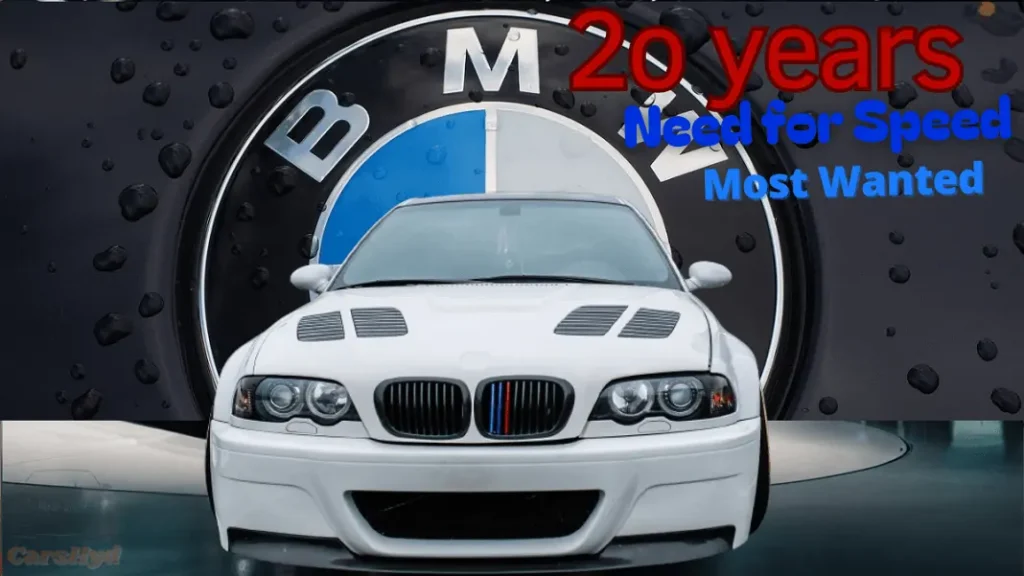
For a generation of automotive enthusiasts and gamers who grew up in the mid-2000s, few race cars evoke the same visceral nostalgia as the 2005 BMW M3 GTR. Whether you were mastering high-speed police pursuits through Rockport City or admiring its bold geometric blue-and-silver livery on the cover of Need for Speed: Most Wanted, the M3 GTR left an indelible mark on modern car culture. Now, more than two decades after its virtual debut, BMW Group Classic has officially bridged the gap between interactive media and physical motorsport history by revealing a fully authentic, real-world tribute to this legendary machine.
This recreation, constructed using an authentic E46 M3 GTR chassis, is far more than a decorative museum piece. It represents a meticulously executed homage to BMW Motorsport’s golden era in North American endurance racing. Built upon the exact platform that dominated the 2001 American Le Mans Series (ALMS) GT category, this vehicle embodies the engineering ambition that allowed drivers Jörg Müller and J.J. Lehto to capture seven victories across 10 grueling races, ultimately sweeping both the Drivers’ and Manufacturers’ Championships for Schnitzer Motorsport.
Contents
Authentic Racing Pedigree & Composite Engineering
Unlike standard aftermarket replicas or cosmetic tribute builds, BMW’s official M3 GTR project retains full GT-spec race architecture. Underneath the iconic paintwork lies a heavily modified chassis engineered specifically for high-downforce endurance circuit racing. BMW’s engineers stripped the cabin of every luxury amenity, leaving only a ultra-lightweight carbon-fiber FIA racing seat, a full-spec integrated roll cage, and a sequential motorsport shifter.
The aerodynamic bodywork and structural safety layout mirror the exact homologation specifications of the 2001 race car. Key highlights include widened carbon-reinforced plastic (CFRP) front and rear fenders, deep side skirts with functional cutouts for side-exit exhaust pipes, center-locking magnesium wheels, and a massive adjustable rear wing. The exterior vinyl wrap was directly calibrated with original art assets provided by Electronic Arts (EA), ensuring every line and color gradient matches the hero car featured in the game.
Under the Hood: The Masterpiece P60B40 V8 Engine
To truly understand why the M3 GTR achieved mythical status, one must look beneath its vented carbon hood. In standard form, the road-going E46 M3 was powered by the critically acclaimed S54 3.2-liter naturally aspirated inline-six. However, to remain competitive against Porsche’s rear-engine 911 GT3 R in the ALMS GT class, BMW Motorsport realized they needed significantly more torque and top-end power.
The solution was the **P60B40**—a custom-designed, 4.0-liter 90-degree naturally aspirated V8 engine created exclusively for competition. As recorded in historical technical archives by MotorTrend, the P60B40 featured a compact aluminum block, dry-sump lubrication, and high-revving internal components that allowed it to produce 444 horsepower at 7,500 RPM and 354 lb-ft of torque. Power was routed to the rear wheels via a 6-speed Hewland sequential transmission and a limited-slip differential, creating a mechanical combination that was virtually unstoppable during the 2001 season.
The Homologation Controversy & Strassenversion Rarity
The M3 GTR’s reign at the top of international motorsport was brilliant, yet remarkably brief. Following BMW’s dominant sweep in 2001, rival manufacturers protested the car’s engine configuration. ALMS and IMSA sanctioning bodies stated that racing vehicles must share a basic engine design with production road cars available to the general public.
To satisfy these regulations initially, BMW produced a limited run of road-legal vehicles known as the **M3 GTR Strassenversion** (Street Version). Priced at approximately €250,000 at the time, these road cars featured a detuned 380-horsepower version of the P60 V8 engine, a stripped interior, and carbon body panels. However, when IMSA revised its rules for the 2002 season—demanding that manufacturers build a minimum of 100 road cars and 1,000 engines to qualify—BMW decided the cost was prohibitive and officially withdrew the factory M3 GTR program from North American competition. Only 10 original Strassenversion units were ever built, making it one of the rarest production BMWs in existence today.
How ‘Need for Speed’ Transformed a Race Car into a Cultural Icon
While its professional racing career lasted just one full season, the M3 GTR found immortal life in digital media. When Electronic Arts released Need for Speed: Most Wanted in November 2005, the M3 GTR was chosen as the primary hero vehicle. The game’s opening sequence immediately placed players behind the wheel of the high-strung V8 coupe, embedding its distinctive gear whine and screaming exhaust note into gaming history.
The car’s inclusion in subsequent titles—such as Need for Speed: Carbon, Heat, and Unbound—solidified its reputation across multiple generations of players. By officially reconstructing this physical car for displays at major events like the **BMW Welt Museum in Munich**, BMW acknowledged the powerful role that video games play in preserving automotive heritage for younger generations.
Exploring Modern BMW Performance & Models?
From modern M-Performance engineering and S58 specs to engine reliability checks, explore our comprehensive BMW Buyer’s Guide or compare models in our general Buyer’s Guides Hub.
Frequently Asked Questions (FAQs)
What is the BMW M3 GTR?
The BMW M3 GTR is a specialized endurance race car developed by BMW Motorsport on the E46 platform. It achieved widespread acclaim by winning the 2001 American Le Mans Series (ALMS) GT Championship and gained legendary pop-culture status as the cover car for EA Sports’ 2005 video game Need for Speed: Most Wanted.
Why did BMW recreate the M3 GTR in real life?
BMW Group Classic recreated the physical vehicle to celebrate two major automotive cultural milestones: the 30th anniversary of the Need for Speed franchise and the 20th anniversary of Need for Speed: Most Wanted, honoring the deep intersection of virtual gaming culture and real-world motorsport history.
What engine powered the race-spec M3 GTR?
The race-spec M3 GTR was powered by the P60B40 4.0-liter V8 engine, specifically engineered by BMW Motorsport for high-output circuit competition. It generated 444 horsepower at 7,500 RPM and 354 lb-ft of torque, paired with a 6-speed Hewland sequential transmission.
Is the recreated M3 GTR street legal?
No, the tribute vehicle is built strictly to track-focused race specifications. It features a completely stripped racing interior, an integrated roll cage, stiffened racing suspension, and a side-exit exhaust system, making it non-compliant for public road use.
Why was the M3 GTR withdrawn from ALMS racing after 2001?
Following protests regarding the V8 engine configuration, ALMS and IMSA updated their rules for 2002, requiring manufacturers to build 100 street-legal production cars and 1,000 engines. Because the M3 GTR utilized a bespoke V8 not offered in standard production E46 models, meeting these production quotas was unfeasible, leading BMW to withdraw the factory team.
How many street-legal M3 GTR Strassenversion units exist?
BMW produced approximately 10 road-going M3 GTR Strassenversion models in 2001 to satisfy initial homologation rules. These rare vehicles featured a detuned 380-horsepower version of the P60 V8 engine and remain among the most valuable and sought-after collector cars in BMW history.