





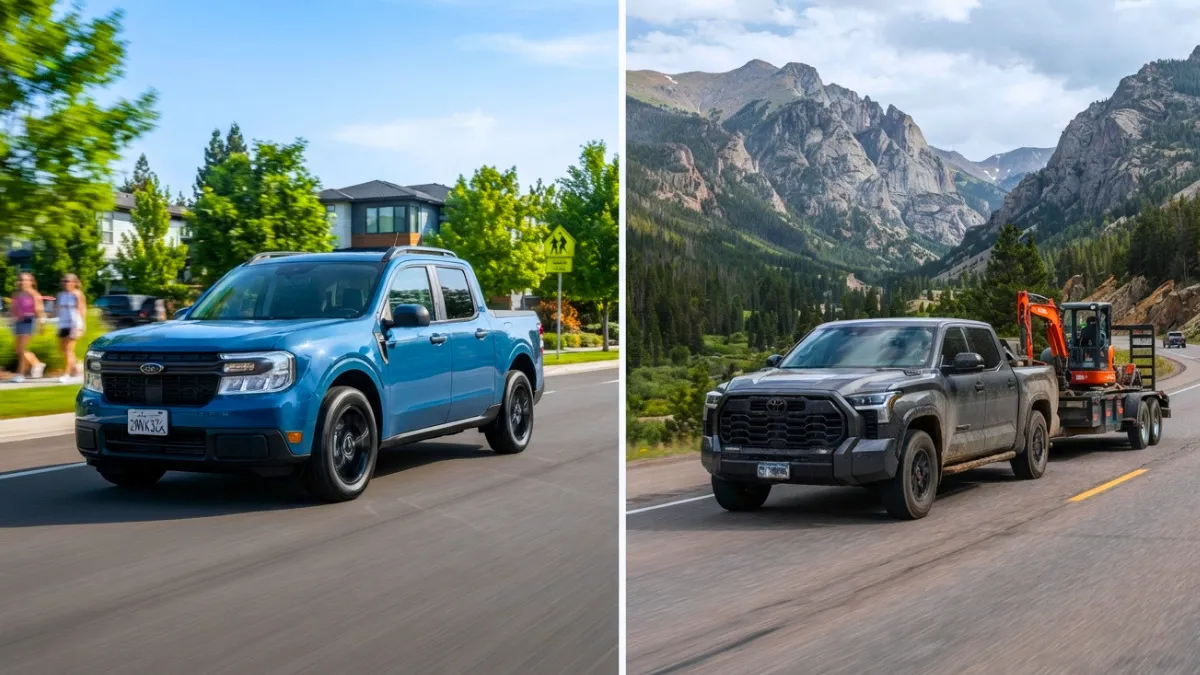
In real-world testing, the Ford Maverick Hybrid averages 38-42 mpg in mixed driving, while the Toyota Tundra Hybrid (i-FORCE MAX) lands closer to 19-21 mpg. While the compact Maverick nearly doubles the Tundra’s fuel efficiency, the full-size Toyota hauls almost three times the payload and offers vastly superior towing capacities. Choosing between these two electrified platforms requires looking past the window sticker to analyze your precise operational needs.
Logging thousands of miles over the past two years reveals that the “hybrid truck” segment has fractured into two completely different mechanical philosophies. This field test evaluates both platforms across real-world commuting, heavy hauling, steep mountain grades, and extreme temperature shifts to determine what these hybrid systems actually deliver at the pump.
In This Article
Why Real-World MPG Matters Here
Official window stickers stem from laboratory testing on simulated chassis dynamometers under strictly controlled temperatures. Real-world commercial use introduces crosswinds, payload weight shifts, aerodynamic drag, and aggressive highway merging profiles that standard testing parameters cannot fully recreate.
When analyzing the market, the Maverick Hybrid’s official 42 city / 33 highway rating and the Tundra Hybrid’s 20 city / 24 highway baseline must be treated as architectural reference points rather than absolute operational guarantees. True efficiency reveals itself at the pump under real thermal and mechanical stress. To cross-reference official government test cycles, buyers can consult the EPA Fuel Economy Database.
Hybrid Truck Specifications & Core Architecture
These vehicles occupy entirely different segments. The Maverick relies on a unibody platform shared with compact crossovers, whereas the Tundra utilizes a traditional fully boxed steel full-size truck chassis. Their mechanical specifications highlight these contrasting engineering goals:
Ford Maverick Hybrid Specs
- Powertrain: 2.5L Atkinson-cycle inline-4 integrated with an eCVT
- Total Output: 191 Horsepower
- Drivetrain Options: Available in both FWD and newer AWD configurations
- Maximum Towing Capacity: 2,000 lbs (FWD) up to 4,000 lbs (AWD with 4K Tow Package)
- Max Payload Safety Margin: 1,500 lbs
Looking for a complete overview of the Maverick? Explore our Ford Maverick Hybrid review, where we cover its features, performance, technology, towing capability, pricing, and ownership experience in detail.
Toyota Tundra Hybrid (i-FORCE MAX) Specs
- Powertrain: 3.4L Twin-Turbo V6 with a parallel electric motor generator and a 10-speed automatic
- Total Output: 437 Horsepower / 583 lb-ft of Torque
- Drivetrain Options: RWD or part-time 4WD
- Maximum Towing Capacity: Up to 11,450 lbs
- Max Payload Safety Margin: Up to 1,940 lbs
The Tundra’s massive 583 lb-ft torque curve demonstrates that Toyota engineered this parallel hybrid system to prioritize severe work capacity and V8-matching low-end power, using electrification primarily as a force multiplier. Detailed powertrain technical breakdowns are accessible through the SAE International Mobility Repository.
Ford Maverick Hybrid: Empirical Test Results
Urban and Suburban Operating Efficiency
Urban environments are where the Maverick’s power splitting eCVT architecture excels. At low speeds, the vehicle operates primarily on electrical energy, keeping the combustion engine disengaged during prolonged idling and stop-and-go crawls. Suburban test loops yielded a highly efficient 41.8 mpg average, with optimal mild-weather commuting tanks climbing to 44.1 mpg. The regenerative braking transition feels exceptionally progressive, capturing kinetic energy seamlessly without mechanical harshness.
Steady-State Highway and High-Load Limits
Sustained interstate cruising at 72 mph returns a lower, yet respectable 34.6 mpg average. This drop occurs because steady highway speeds require the 2.5L internal combustion engine to run continuously, shifting the efficiency burden onto the truck’s boxy aerodynamic profile. When loaded with a 1,000-lb payload payload, fuel economy settles to 29.3 mpg. High-elevation mountain climbs dropped efficiency further to 31.7 mpg, reflecting the increased physical strain placed on the naturally aspirated four-cylinder engine.
Cold Weather Operational Performance
Testing in winter climates reveals clear physical boundaries for small-displacement hybrid systems. On short commutes in sub-freezing temperatures, the Maverick’s fuel economy dropped sharply to 26.4 mpg. This efficiency loss stems from the engine management software running the combustion unit continuously to reach optimal catalyst operating temperatures and supply cabin heat, preventing the vehicle from entering pure electric mode.
Toyota Tundra Hybrid: i-FORCE MAX Efficiency Data
Suburban Commuting and Highway Cruising
The Tundra i-FORCE MAX returned a consistent 19.4 mpg average across suburban test loops. Unlike a traditional power-split hybrid, Toyota’s configuration uses its electric motor to fill the torque curve during transmission gear changes rather than relying on pure-electric propulsion. Steady-state highway driving showed an improvement to 21.8 mpg, illustrating that the twin-turbo V6 operates efficiently when turning low RPMs in 10th gear.
Payload Hauling and Commercial Towing Manners
Placing 1,000 lbs of weight into the bed resulted in a stable 18.2 mpg average, while steep mountain grades dropped performance slightly to 17.9 mpg. Though fuel consumption increases under load, the powertrain remains exceptionally composed. The integrated electric motor provides immediate throttle response, preventing annoying transmission hunting on steep highway inclines. When pulling a 6,500-lb commercial travel trailer, real-world fuel consumption dropped to 12.1 mpg, outperforming many non-hybrid V8 trucks under identical towing configurations.
Head-to-Head Real-World MPG Summary
| Driving Scenario | Ford Maverick Hybrid | Toyota Tundra Hybrid |
|---|---|---|
| Suburban Commute | 41.8 mpg | 19.4 mpg |
| Highway Cruise (70-75 mph) | 34.6 mpg | 21.8 mpg |
| Loaded Payload (~1,000 lbs) | 29.3 mpg | 18.2 mpg |
| Mountain Elevation Grades | 31.7 mpg | 17.9 mpg |
| Cold Start Short Commutes | 26.4 mpg | 17.5 mpg |
| Towing (6,500 lbs Trailer) | Not Rated for Weight | 12.1 mpg |
Operational Verdict: Which Truck Matches Your Workflow?
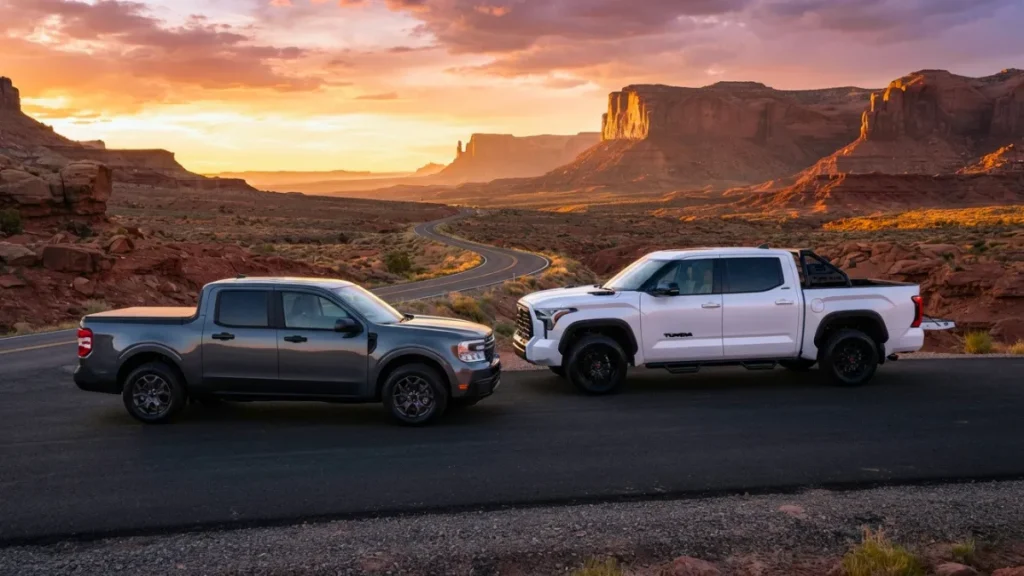
The stark difference in fuel consumption comes down to basic physics rather than a flaw in either hybrid system’s engineering design. The Maverick’s light 3,700-lb curb weight and smaller frontal area minimize physical rolling resistance and aerodynamic drag. Conversely, the 5,700-lb Tundra utilizes its hybrid componentry to optimize mechanical torque and chassis capability over pure fuel economy metrics. For official towing rules and safety compliance frameworks, check the U.S. Department of Transportation Guidelines.
The Ford Maverick Hybrid is the correct choice if: Your daily workflow consists primarily of urban commuting, light tool transportation, property management routes, and local service calls where fuel operating costs are your primary financial metric.
The Toyota Tundra Hybrid i-FORCE MAX is the correct choice if: Your business demands regular medium-to-heavy towing, high payload limits, robust structural stability on unimproved job sites, and uncompromised full-size utility.