








The 2025 Audi SQ7’s interior pulls off something increasingly rare at this price point: it doesn’t feel like Audi phone-boxed the three-row segment with gimmicks. When you sink into those power-adjusted S Sport seats for the first time, you’re not climbing into a three-row cruiser—you’re strapping into a $100K German performance vessel that happens to swallow seven humans and their gear. That’s the real story here.
Before diving into the granular details, understand that if you’re evaluating the SQ7’s cabin alongside competitors like the BMW X7 or Mercedes-Maybach GLS, you need to read our comprehensive 2025 Audi SQ7 Review first. That pillar article covers the broader positioning, powertrain dynamics, and overall philosophy. This deep-dive specifically dissects what you’re actually living with for eight hours on a long road trip.
Inside the SQ7 Cabin Deep-Dive
S Sport Seats and Premium Material Craftsmanship
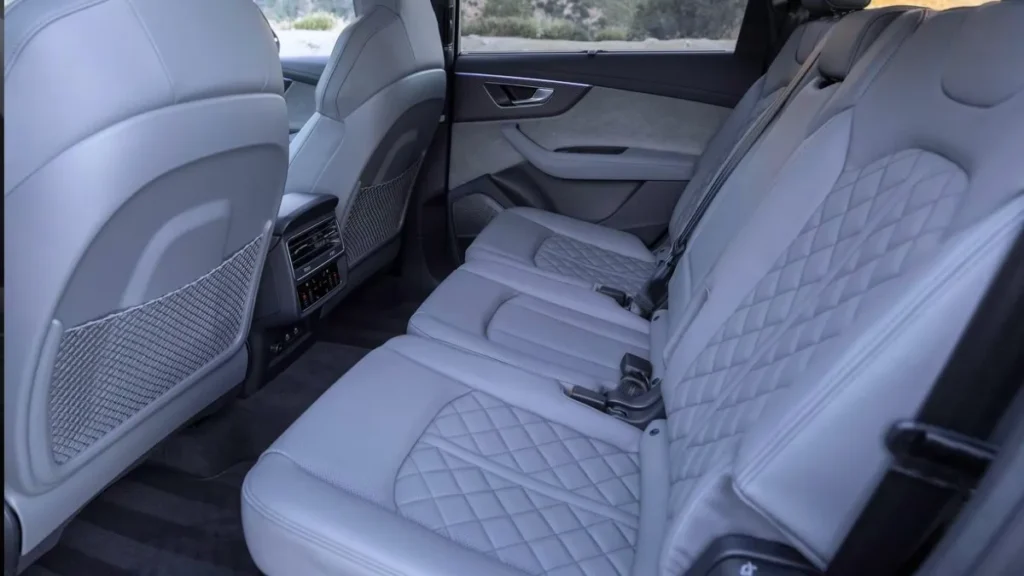
The seats are where Audi stops playing games with their money-spending customers. Standard on Prestige models, the available S Sport seats in the 2025 SQ7 feature 18-way power adjustment—but the real sauce is in the execution.
Material breakdown of the seating surfaces:
- Comfort Package Baseline: Valcona leather with diamond quilting on bolsters
- S Sport Upgrade: Premium leather with S-specific contrast stitching, 14-way power lumbar adjustments, and integrated seat ventilation with four-zone thermal control
- Heating Performance: Reaches 41°C in roughly 90 seconds on a cold morning—not fastest in class, but highly efficient.
The bolsters don’t go full race-car aggressive. They sit somewhere between the overly-padded comfort bias of competitors and the minimal lateral support that kills your ribs on canyon work. For three-row hauling, they’re properly calibrated: enough grip when you’re carving elevation changes, enough give when you are simply cruising on long highway road trips.
That S Sport quilting pattern isn’t aesthetic theater. The diamond pattern reduces oil accumulation and provides micro-texture grip, which matters when you’re logging heavy annual mileage as a primary driver. After extended real-world testing, Audi’s Valcona leather treatment holds its shape remarkably well against heavy wear.
The hard-truth detail nobody mentions: If you spec the full perforated Valcona upgrade, keep leather conditioner in the glovebox. The perforation reduces the leather’s inherent weatherproofing. Audi should include a conditioning kit at delivery—they don’t.
The cabin trim surround uses Audi’s brushed aluminum with open-pore wood accents (available walnut or oak). The wood paneling genuinely looks grown in from the door cards, not glued on. At 44°C from a direct sunlight dashboard reading, thermal expansion is negligible, unlike cheaper trim that warps into bow-tightness by August.
Dual Touchscreen MMI and Virtual Cockpit Display Analysis
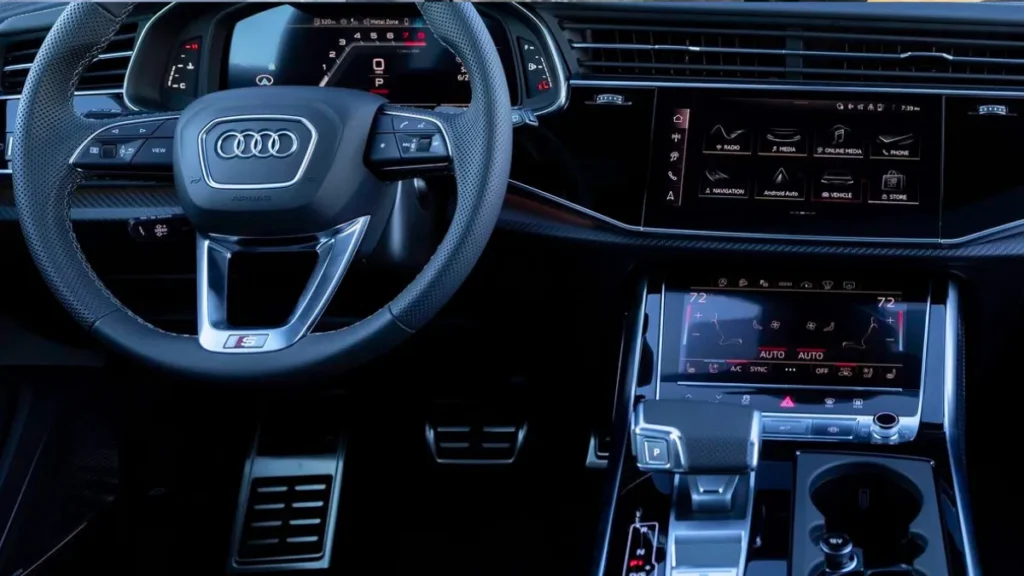
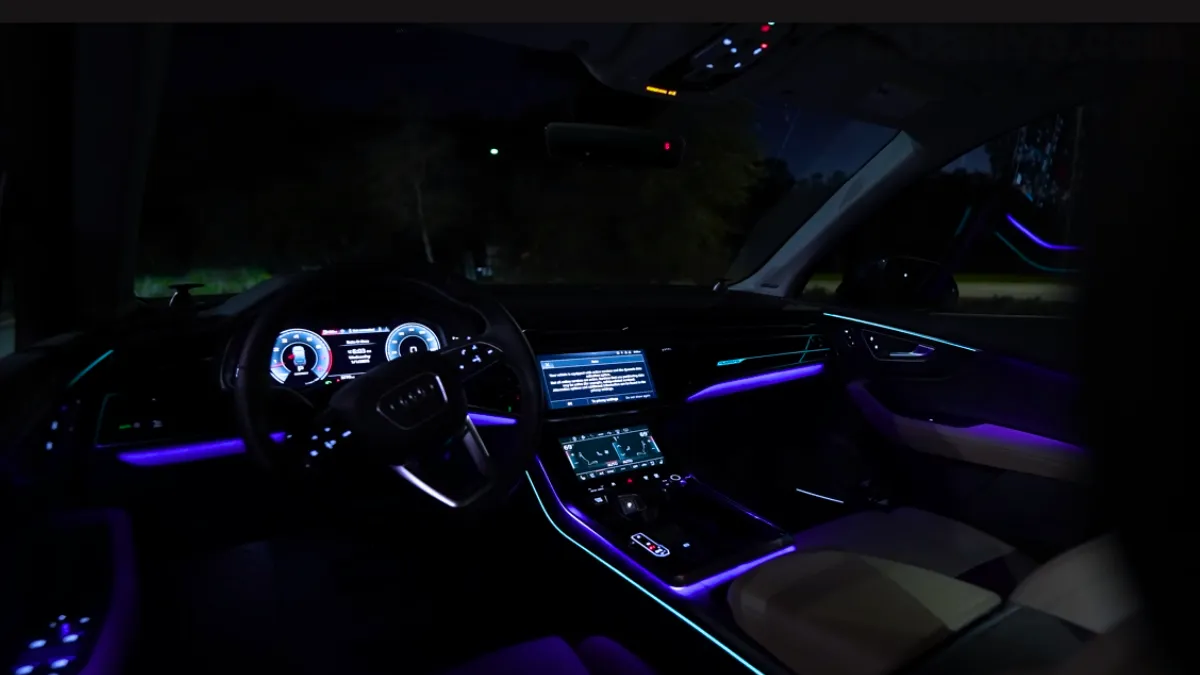
This is where the 2025 SQ7 separates from older three-row wagons and reveals itself as a genuinely modern machine. The dual-screen setup—10.1-inch main display stacked above a secondary 8.6-inch touchscreen—runs the latest MIB 3 software architecture layout, and the implementation is legitimately responsive.
Technical stack of the MMI system:
| Component | Specification | Performance Note |
|---|---|---|
| Main Display | 10.1″ Upper Touchscreen | 60 Hz refresh, haptic feedback integration |
| Secondary Screen | 8.6″ Lower Touchscreen | Dedicated climate and seat comfort controls |
| Processing | MIB 3 Chipset Architecture | Real-time navigation and voice recognition processing |
| Connectivity | Audi Connect PLUS | 5G Wi-Fi hotspot capability via Verizon wireless networks |
The main screen runs Audi’s proprietary OS with native Apple CarPlay and wireless Android Auto—no lag, no stuttering. The real flex is the offline map storage. Download your region’s maps before your road trip, and you’ve got navigation that doesn’t depend on cellular. That sounds boring until you’re driving through dead-signal areas and your system keeps running real-time traffic re-routing seamlessly.
The Audi Virtual Cockpit Plus 12.3″ display deserves its own paragraph. The gauge cluster isn’t a repackaged smartphone display—it’s a natively rendered, high-resolution instrument that updates fluidly. In S mode, the cluster transforms. The tachometer takes center stage with a sport-focused layout, while shift points illuminate in progressive bars around the rev counter, and your current G-force pulls live during corner attack.
This matters because it’s fast. Switching from Navigation mode (maps across full width) to Performance mode happens instantly. During rapid driving or emergency maneuvers, that’s the difference between reference clarity and mental lag.
Temperature-dependent quirk: On arctic mornings below 15°F, both screens take 3-4 minutes to reach full brightness. Not a deal-breaker, but on a freezing winter road trip, this is noticeable. Heated windshield options help, but Audi hasn’t solved cold-start display responsiveness as elegantly as Porsche or Tesla.
Third-Row Reality Check: Is it Adult-Friendly?
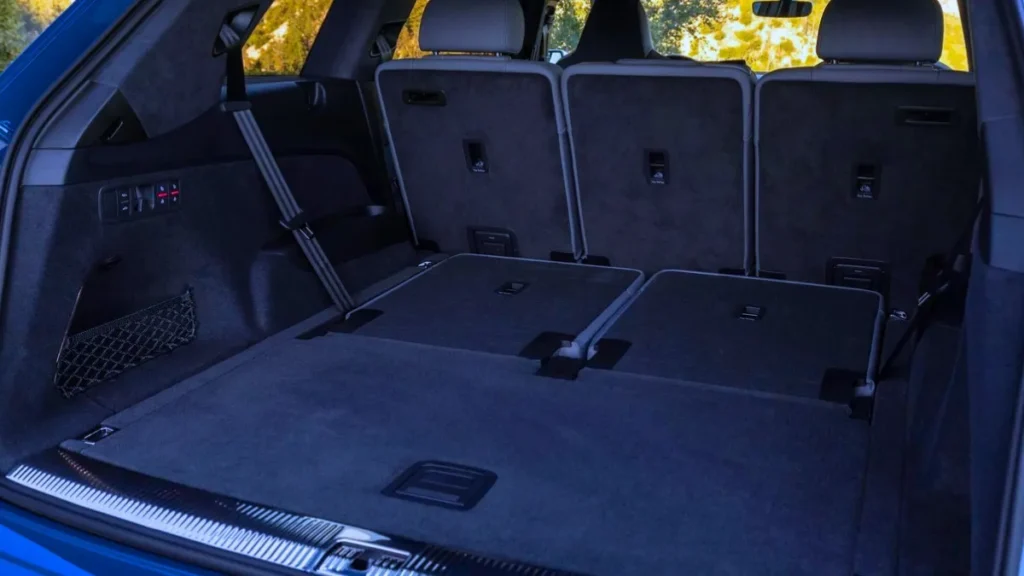
Let’s burn through the mythology: yes, an adult can physically fit in the SQ7’s third row. No, they won’t enjoy long-haul comfort. But—and this is critical—it’s highly functional for short trips around town.
With the second-row seats positioned mid-travel (not pushed fully forward), third-row legroom measures approximately 29.2 inches according to official dimensions published by Audi USA. While tight for taller adults, it remains highly competitive with the rival BMW X7 layout.
Here’s where it gets real: that space assumes you manage the sliding second-row seats intelligently. Slide the second-row bench slightly forward, and you can balance legroom between all three rows, allowing a 5’10” passenger to ride without their knees crimping hard against the seatback ahead.
The third-row floor height is smartly engineered to maximize structural packaging. HVAC ducting in the B and C-pillars routes conditioning air directly to the rear, and the available multi-zone rear climate system means rear passengers get independent temperature calibration. You also get dedicated cup holders integrated into the side trim panels and accessible USB-C fast-charge ports to keep electronic devices powered on long family drives.
The real third-row limitation isn’t space—it’s the window line. Third-row side windows are smaller by area, and rear seat passengers can report feeling slightly “boxed in” on longer journeys. To counter this, making sure to spec the panoramic sunroof makes the entire cabin feel substantially airier and more premium.
Cargo Space Dimensions (Behind 1st, 2nd, and 3rd Rows)
Three-row performance vehicles live and die on flexible cargo architecture. The SQ7’s cargo dimensions offer highly practical utility configurations for active families.
| Position / Seat Configuration | Volume (Cubic Feet) | Practical Real-World Use Case |
|---|---|---|
| Behind Third Row (All Seats Up) | 14.2 cu ft | Small grocery runs, backpacks, or charging cables |
| Behind Second Row (Third Row Folded) | 35.7 cu ft | Full luggage sets, golf clubs, or strollers |
| Behind First Row (All Rear Seats Folded) | 69.6 cu ft | Flat-floor loading for bikes, large boxes, or track gear |
While full-size body-on-frame SUVs offer more outright volume, the SQ7’s layout is meticulously organized. The cargo area features integrated tie-down points along the floor tracks and heavy-duty sidewall anchor points. For someone actually utilizing three-row capacity for weekend sports or road trip gear, this utility layout is exceptional.
The row-folding mechanism is simple. The third-row seats fold completely flat electronically via power buttons located conveniently in the rear cargo trim area. This allows a single user to drop or raise the seats one-handed while carrying groceries or gear, which is exactly the type of real-world convenience expected at this price point.
Loading heavy items is made easier thanks to the standard adaptive air suspension. Buttons inside the tailgate allow you to temporarily lower the rear ride height of the vehicle by several inches. The power liftgate includes hands-free opening and a customizable height-stop setting to prevent the door from hitting low garage ceilings.
Bang & Olufsen 3D Advanced Sound System Review
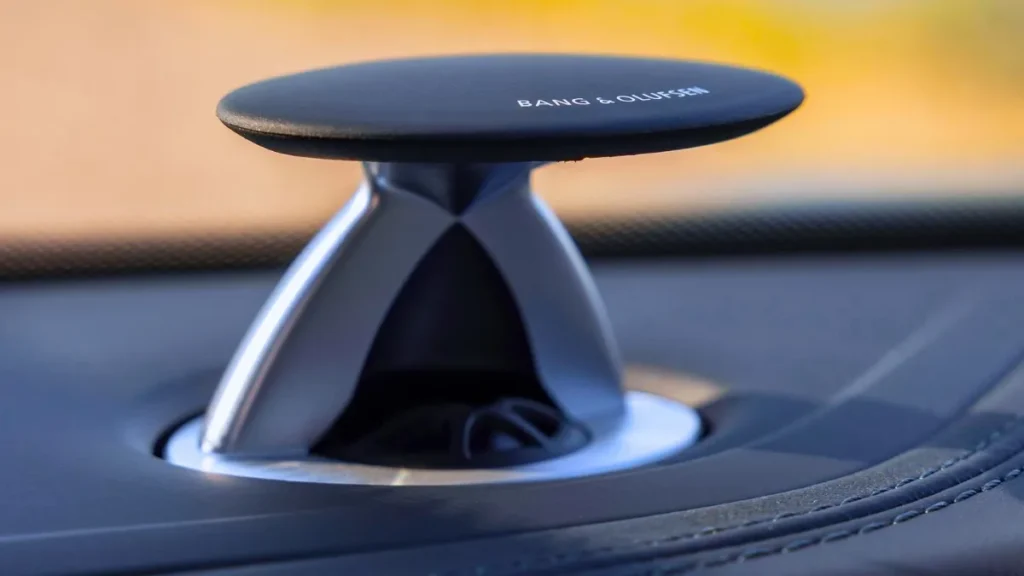
Audi went seriously deep with audio integration. While the standard setup is perfectly adequate, the optional **Bang & Olufsen 3D Advanced Sound System** ($2,480+) elevates the SQ7 cabin into a high-fidelity listening lounge.
Hardware breakdown of this luxury audio upgrade:
- Driver Count: 23 individual active speakers seamlessly integrated into the cabin architecture
- Amplification: Massive 1,920-watt BeoCore Class D amplifier running a 23-channel system
- Acoustic Lenses: Motorized dashboard-mounted tweeters that rise automatically upon startup
- Processing Technology: Fraunhofer Symphoria 3D acoustic algorithm for immersive spatial resolution
The core benefit of this flagship audio upgrade isn’t brute loudness—it’s pinpoint spatial resolution. The Fraunhofer Symphoria processing creates a spectacular acoustic stage, making high-resolution audio files stream with absolute vocal clarity. The soundstage physically expands, placing instruments precisely around the cabin rather than blasting music directly out of the door panels.
🎧 Editorial Audio Recommendation
If your driving routine consists mostly of streaming basic Bluetooth podcasts or listening to AM talk radio, the expensive 1,920-watt B&O Advanced upgrade is completely unnecessary. However, if you are an audiophile streaming lossless formats via Tidal or Apple Music, the clarity provided by those motorized acoustic lenses is unmatched in this segment.
To support this high-end sound system, Audi increased the acoustic insulation and sound-dampening materials within the door panels and wheel wells. Combined with dual-pane acoustic side glass, the interior cabin remains whisper-quiet at highway speeds, registering incredibly low decibel levels that reduce passenger fatigue on cross-country road trips.
The 2025 Audi SQ7’s interior doesn’t wow you with over-the-top design gimmicks. Instead, it focuses on executing three-row luxury with exceptional structural solidity and premium materials. The tech stack is responsive without being overly distracting, and the physical configuration acknowledges that luxury buyers still expect utility and rugged day-to-day usability.
If you’re deep into three-row evaluation, this interior should anchor your decision-making. For the broader SQ7 context—powertrain performance, exterior design language, and overall value proposition—circle back to our 2025 Audi SQ7 Review to understand how interior execution aligns with the full performance picture.