











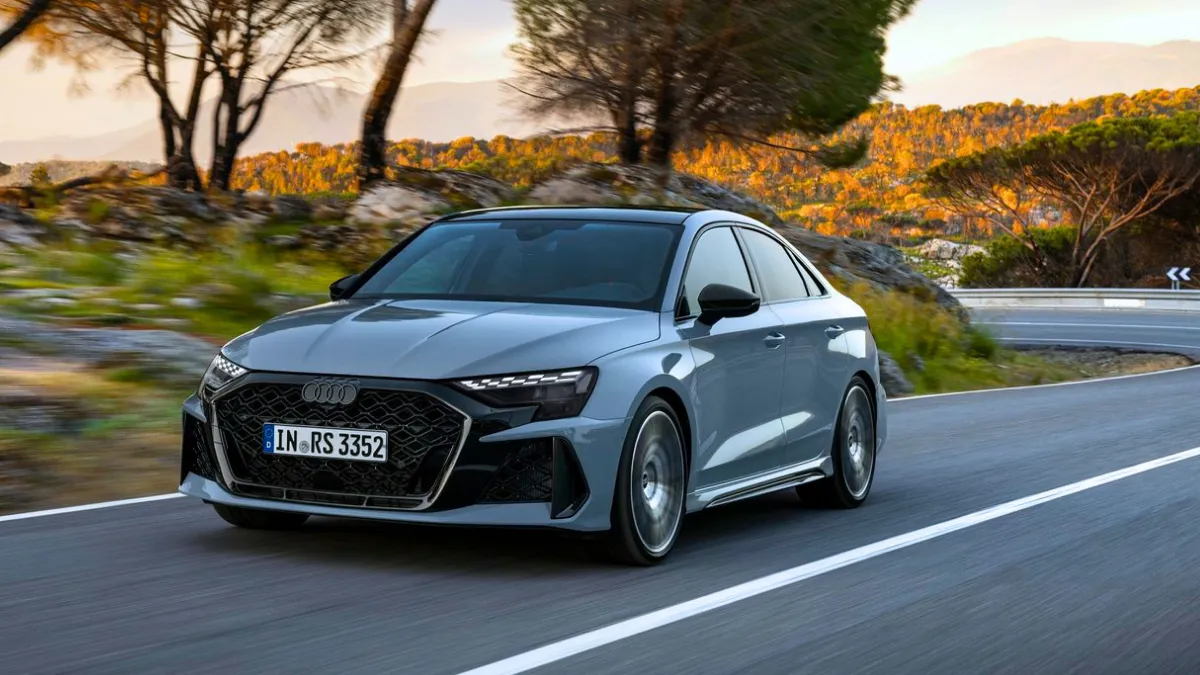
There are engines that move cars, and then there are engines that move people. The 2.5-liter turbocharged inline-five sitting under the hood of the 2026 Audi RS3 belongs firmly in the second category — it’s one of the last true mechanical personalities left in a segment being rapidly strangled by efficiency mandates and electric drivetrains. If you’ve already dug into the full 2026 Audi RS3 performance breakdown, you know this car punches well above its footprint. But the engine itself deserves its own deep dive, because the engineering story behind it is far more interesting than any spec sheet suggests.
Contents
2026 Audi RS3 Engine Specs at a Glance
The Technical Mastery of the 2.5L TFSI Inline-Five
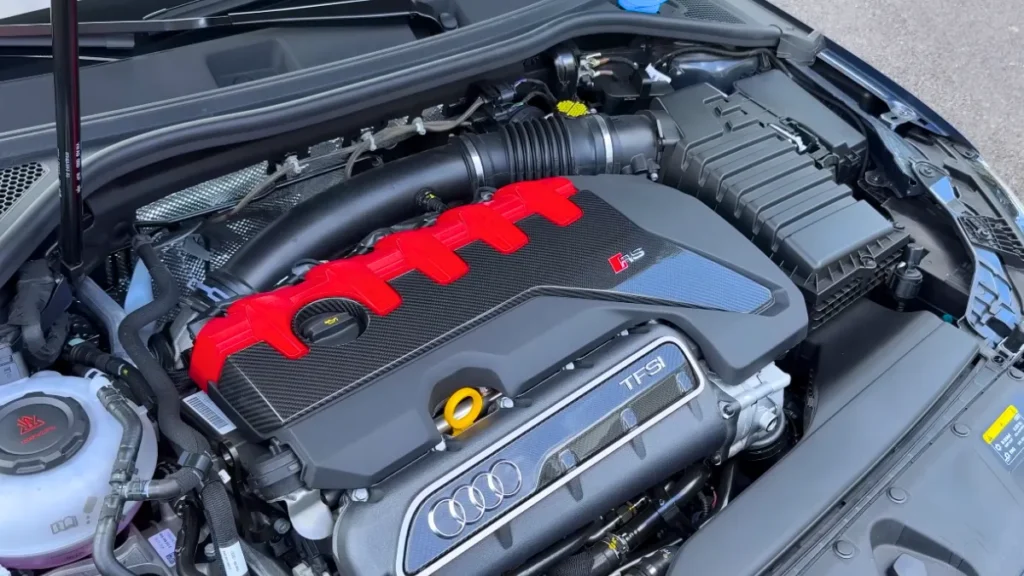
Let’s start with the thing that makes this engine instantly recognizable from a quarter mile away: the sound. That distinctive warble — part motorcycle, part V10, all mechanical chaos — isn’t an accident. It’s the direct acoustic consequence of Audi’s firing order: 1-2-4-5-3.
Why the 1-2-4-5-3 Firing Order Sounds So Unique
In a conventional inline-four, combustion events are evenly spaced at 180-degree crankshaft intervals, producing that flat, symmetrical four-cylinder drone. A straight-six fires every 120 degrees — butter-smooth, almost too refined. The five-cylinder sits in neither camp. With five cylinders sharing a crankshaft, you cannot achieve perfectly equal firing intervals. The math just doesn’t work. Instead, Audi engineers created alternating 144-degree and 216-degree combustion intervals. That asymmetrical rhythm creates overlapping power pulses impossible to reproduce with any other cylinder layout.
The result is an exhaust note with an irregular, almost syncopated rhythm that has no clean analog in the automotive world. Audi’s own engineers have described it as resembling a “miniature V10,” and that’s not just marketing spin — the acoustic profile genuinely shares harmonic characteristics with 90-degree V10 configurations that fire in a similar non-uniform pattern. The famous Audi Sport Quattro and the original Group B rally cars ran this same basic architecture, and the lineage runs directly through to this 2026 unit. You’re hearing 40-plus years of motorsport DNA every time you mash the throttle. Audi’s five-cylinder heritage traces directly back to the legendary Audi Sport quattro Group B rally program, which helped establish the distinctive sound and engineering philosophy that still defines the modern RS3.
Closed-Deck Engineering and High-Boost Durability
The block itself is an aluminum-silicon alloy structure, not the pure cast-iron unit some older enthusiasts mythologize. Audi transitioned away from the heavier iron architecture with the EA855 generation, and the current 2.5 TFSI (internal designation EA855 EVO2 in its 2026 tune) uses a closed-deck aluminum block with plasma-sprayed cylinder bores. That closed-deck design — where the cylinder sleeves are fully surrounded by the block structure rather than open at the top — is the same approach used in serious performance engines from Porsche GT division and high-output BMW M units. It dramatically increases rigidity under boost, which matters enormously when you’re asking a five-cylinder to sustain high combustion pressures across an asymmetric firing sequence.
The cylinder head is equally trick. Audi runs a dual-overhead-cam setup with variable valve timing on both the intake and exhaust camshafts — not just intake-side lift variation like you see in budget performance engines. The exhaust-side variable timing allows the ECU to dial in optimal overlap during boost buildup, reducing turbo lag by keeping exhaust pulses more coherent at low RPM. At higher revs, the timing shifts to maximize flow and top-end punch.
How the Twin-Scroll Turbo Reduces Lag
The turbocharger itself deserves attention. Audi specs a twin-scroll unit that pairs cylinders 1-2 and 3-4-5 into separate scroll entries — a configuration that, again, is made possible by (and specifically tuned around) the 1-2-4-5-3 firing order. By grouping cylinders whose exhaust pulses don’t interfere with each other into shared scroll entries, the turbo sees cleaner, higher-energy exhaust gas at lower engine speeds. The practical effect: boost builds earlier and holds more linearly across the power band than a comparable single-scroll setup.
Power Output: 2026 Audi RS3 Horsepower and Torque Ratings
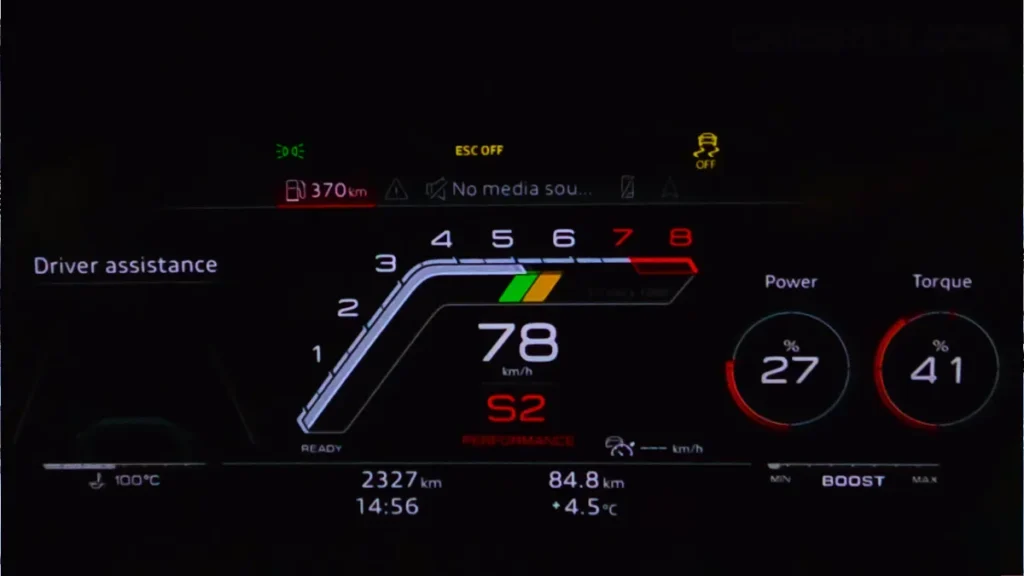
The US-spec 2026 RS3 makes 401 horsepower at 5,600–7,000 rpm and 369 lb-ft of torque from 2,250–5,600 rpm. That torque plateau is not a typo — the engine holds peak twist across a 3,350-rpm window, which is the functional reason this car feels like it pulls like a freight train from virtually any gear, at virtually any speed.
For context, the BMW M2 in its 2026 configuration makes 473 hp but from a 3.0-liter straight-six that needs to rev harder to access its peak output band. The Mercedes-AMG A45 S — the RS3’s most direct European rival — makes 415 hp from a 2.0-liter four-cylinder, but that engine is running at the absolute mechanical edge of what a production four-pot can sustain. The Audi’s 2.5 liters of displacement gives it thermal and structural headroom that the AMG engine simply doesn’t have.
2026 RS3 Engine vs. Key Rivals — Performance Spec Comparison
| Specification | 2026 Audi RS3 | 2026 Mercedes-AMG A45 S | 2026 BMW M2 |
|---|---|---|---|
| Engine Configuration | 2.5L Turbo Inline-5 | 2.0L Turbo Inline-4 | 3.0L Turbo Inline-6 |
| Peak Horsepower (US) | 401 hp @ 5,600 rpm | 415 hp @ 6,750 rpm | 473 hp @ 6,250 rpm |
| Peak Torque | 369 lb-ft @ 2,250 rpm | 369 lb-ft @ 5,000 rpm | 406 lb-ft @ 2,650 rpm |
| Torque Plateau Width | ~3,350 rpm | ~750 rpm | ~2,500 rpm |
| Redline | 7,200 rpm | 7,200 rpm | 7,200 rpm |
| Displacement per Cylinder | 500cc | 500cc | 500cc |
| Forced Induction | Twin-scroll turbo | Twin-scroll turbo | Twin-scroll turbo |
Performance specifications referenced from official manufacturer technical documentation published by Audi Sport, BMW M, and Mercedes-AMG.
Why the RS3 Feels Faster Than the Numbers Suggest
The torque plateau comparison in that table tells you everything about why the RS3 is such a street-fight weapon. The AMG A45 S makes identical peak torque numbers on paper, but it only holds that figure across a roughly 750-rpm window. In real-world driving — canyon carving, highway on-ramp pulls, stoplight-to-stoplight sprints — the Audi’s fat torque curve means you’re almost never outside of peak thrust, regardless of where you are in the rev range.
Power delivery starts building meaningfully around 2,000 rpm. By 2,250 rpm you’re at full torque, and that figure stays pinned until 5,600 rpm where horsepower peaks and dominates the equation through the 7,200-rpm redline. In a seven-speed dual-clutch transmission — the only gearbox Audi offers in the US RS3 — short-shifting at 4,000 rpm in Comfort mode still puts you comfortably inside the peak torque band in the next gear. In Dynamic mode with manual paddle control, rowing gears up near the redline rewards you with that warbling five-cylinder crescendo that no amount of synthetic exhaust augmentation can fake.
Real-World Acceleration and Launch Control Performance
The 0-60 mph sprint comes in at 3.7 seconds in RS Torque Rear mode with launch control armed. That’s with the Torsen-based RS Sport quattro AWD system biasing up to 100% of torque to the rear axle — a configuration that effectively turns the RS3 into a rear-drive-feeling machine without the instability that would imply. On a prepared surface, 3.5 seconds is achievable with aggressive launch control engagement.
The top speed is electronically limited to 155 mph in standard configuration, with the optional RS Dynamic package lifting that ceiling to 174 mph — at which point the aerodynamics, tire ratings, and chassis dynamics become the limiting factors, not the engine’s willingness to keep pulling.
The Mechanical Longevity of the Audi Turbo Five
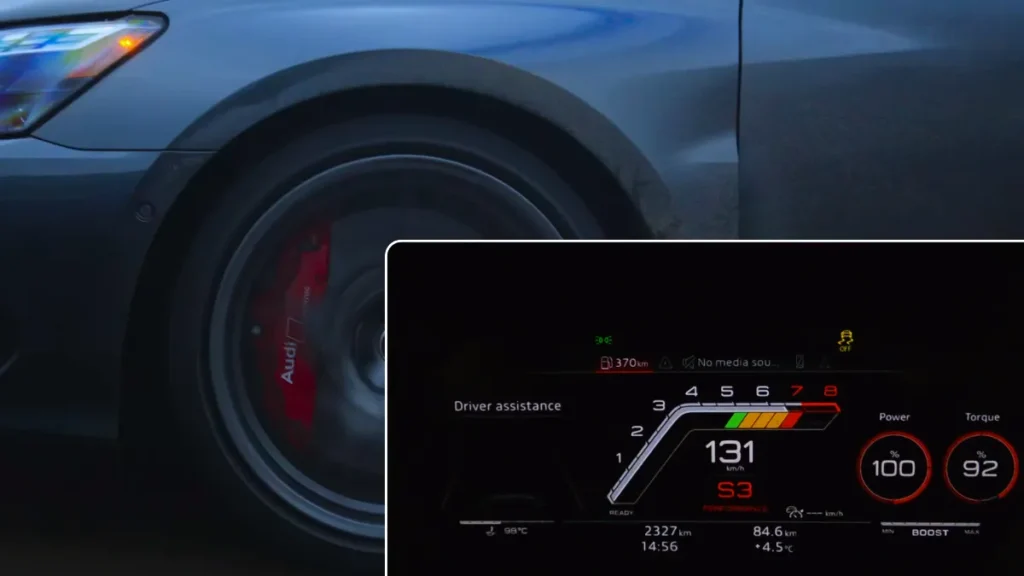
Here’s where the Audi 5-cylinder separates itself from the disposable-feeling performance hardware in some competitors: it’s genuinely, demonstrably reliable at high outputs. The EA855 family has been in continuous production and development since 2009, and the real-world durability record is exceptional for a high-boost performance application.
The closed-deck aluminum block that aids rigidity under boost also aids thermal management. Cylinder bore distortion — where combustion heat and pressure cause the bore to deform slightly from circular, accelerating ring wear — is far less pronounced in a closed-deck architecture than in an open-deck design. Audi’s plasma-sprayed bore surfaces add an additional layer of wear resistance. The combination means the engine maintains tight ring seal and consistent compression ratios well beyond what most turbocharged fours achieve at comparable mileage.
Why the EA855 EVO2 Is So Tuner-Friendly
The factory forged steel crankshaft and powder-metal connecting rods are engineered for substantially more load than the stock 369 lb-ft tune applies. This is where the tuning community has validated what Audi’s engineers built: the EA855 EVO2 block is routinely pushed to 500–550 whp on modified cars with upgraded fuel systems and recalibrated ECU maps, without internal modifications. The head gasket, oil delivery system, and lower-end rotating assembly were overbuilt relative to the stock application from day one — a common Audi RS engineering philosophy that mirrors what Porsche does with the 911 GT3’s bottom end.
Cooling is a legitimately impressive part of the package. The RS3 runs a dedicated intercooler mounted in the front bumper, separate from the main radiator circuit, with a supplemental water-cooled charge air system. Under sustained hard driving — not just a single drag strip blast, but actual extended track use — inlet air temperatures stay dramatically more consistent than on the AMG A45 S, which has documented heat-soak issues during back-to-back launch control runs. Mopar guys and dedicated sports car folks who’ve cross-shopped the RS3 consistently point to this thermal composure as a major factor in their decision.
At the maintenance level, the 5-cylinder requires no exotic service intervals. Oil changes every 10,000 miles on full synthetic, standard spark plug replacement at 40,000-mile intervals, and a timing chain (not a belt) that Audi rates for the life of the engine under normal operating conditions. The direct-injection setup does accumulate carbon on intake valves over time — an inherent limitation of GDI systems — but Audi’s port injection secondary circuit (the dual-injection system present on the EVO2) dramatically reduces deposit buildup compared to the earlier EA855 units that lacked this feature.
Daily Driving Characteristics of the RS3 Engine
For daily driver use, the 5-cylinder is an unremarkable commuter. It starts cold without drama, idles smoothly, and doesn’t demand premium attention. It doesn’t feel stressed at 75 mph on the highway because at 75 mph in seventh gear, it’s barely above idle. The power reserve is vast. That’s what 2.5 liters of displacement bought you — not just the sound, but the mechanical ease of an engine that’s barely breathing when you don’t need it to.
The Bottom Line
No other production engine in 2026 sounds like the Audi five-cylinder. No other engine in this class offers the same combination of tractable low-end torque, high-rpm willingness, proven long-term reliability, and genuine tuning headroom under the hood of a car that you can actually daily drive without managing it. The firing order that creates that addictive warble also enables the twin-scroll turbo packaging that gives the engine its flat, broad power curve. Every unusual design choice compounds into a coherent engineering philosophy.
Dig deeper into how this engine translates to real-world quarter-mile results and brutal straight-line 0-60 times in our next breakdown. And if you’re still weighing the full picture — chassis, AWD system, interior, and how the RS3 compares to its class in total — the complete 2026 Audi RS3 review covers every dimension of why this compact super sedan earns every dollar of its asking price.