



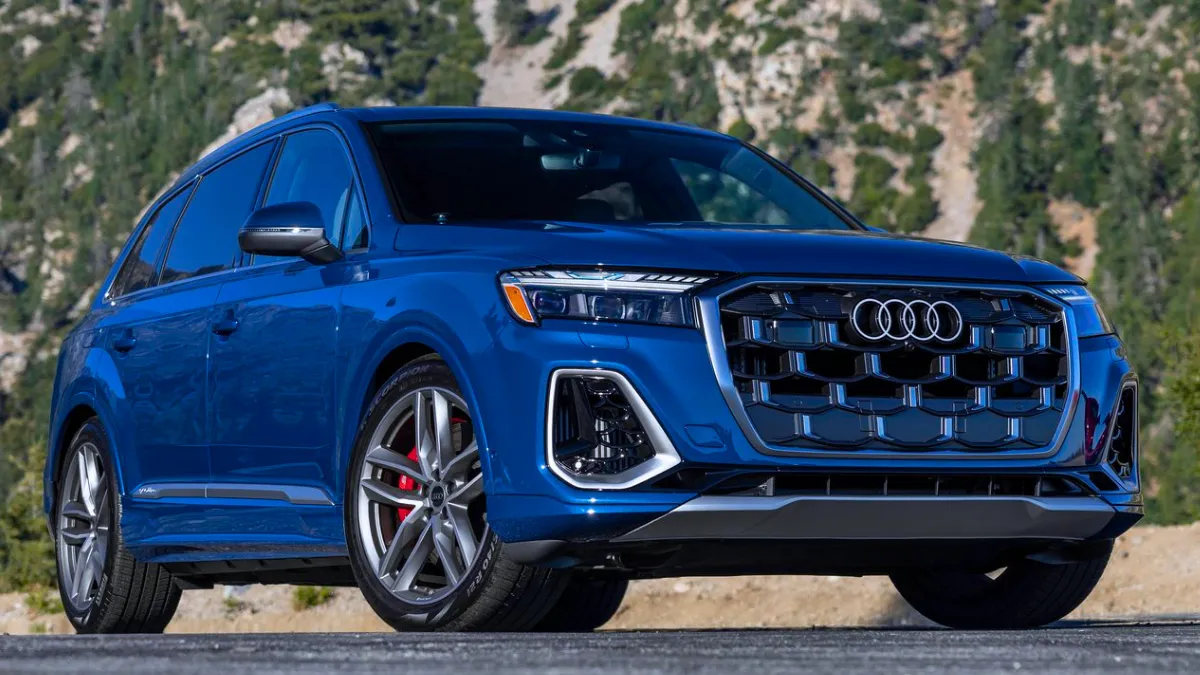
The 2025 Audi SQ7 is a twin-turbocharged, 500-horsepower, three-row performance SUV that starts at $90,800 in the US. It sprints to 60 mph in just 4.0 seconds, seats seven, and wraps the whole package in genuine German luxury. If you’ve ever wanted a vehicle that hauls soccer gear on Tuesday and humiliates sports cars on Saturday, the SQ7 is your answer.
Here’s the thing about the Audi SQ7: it doesn’t ask you to choose. Most family SUVs make a quiet, unspoken compromise—sure, they’ll move seven bodies and a dog crate, but don’t expect your pulse to quicken. The SQ7 refuses that deal entirely. It’s one of the few vehicles I’ve driven where the third row actually folds flat and the throttle response makes you grin like an idiot.
Our test team spent two weeks with a fully loaded 2025 SQ7 Prestige in Glacier White Metallic—$104,895 out the door before options—and put it through canyon roads in California, school runs in suburban traffic, and a stretch of empty Nevada interstate where the speedometer climbed well past the point I’d be comfortable printing here. What we found was a machine that plays its paradox with complete confidence.
It’s not perfect. Nothing at this price point ever is. But the SQ7 occupies a very specific, very compelling lane in the 2025/2026 American luxury SUV market—one that the BMW X5 M60i can’t fully reach and the Porsche Cayenne can’t quite justify for family duty.
Let’s break it all down.
Contents
2025 Audi SQ7 Price and US Trims
The SQ7 arrives in the US in two trim configurations: Premium Plus and Prestige. Both are built on the same mechanical foundation—same engine, same Quattro AWD system, same adaptive air suspension. The differences land squarely in the luxury and technology departments.
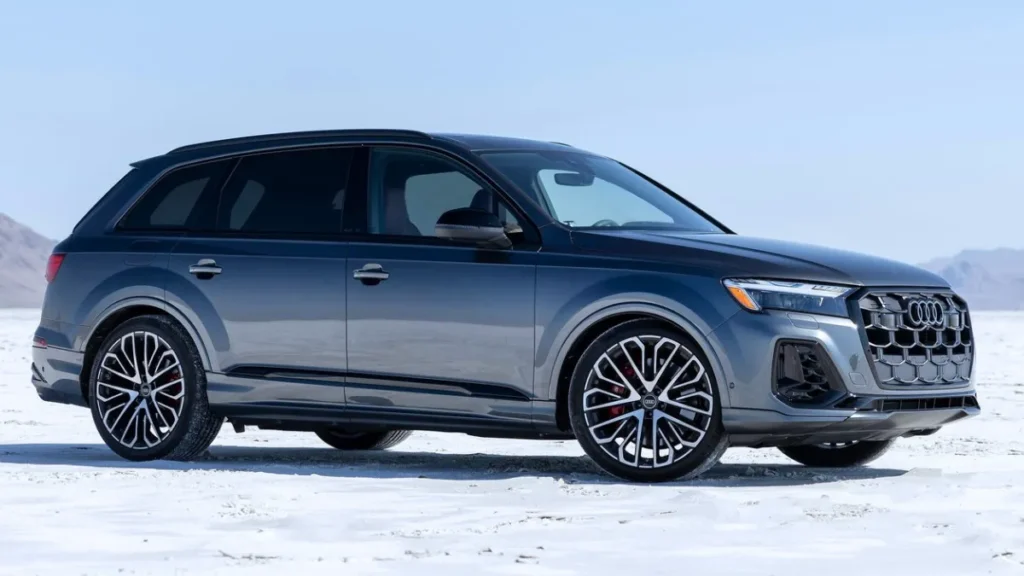
Premium Plus vs. Prestige: Which Trim to Buy?
The Premium Plus starts at $92,395 and is, frankly, already a remarkable amount of car. Standard equipment includes the 4.0L twin-turbo V8, a panoramic sunroof, Audi’s Virtual Cockpit Plus, the dual MMI touchscreen setup, 21-inch wheels, Valcona leather seating, and the full Audi pre sense safety suite.
Where the Prestige justifies its $96,900 base price is in the details that separate “luxury” from “executive luxury.” You get the Executive Package as standard, which bundles the 23-speaker Bang & Olufsen 3D Premium Sound System, four-zone automatic climate control, and rear-seat entertainment. The headline add is Matrix LED headlights with laser high beams—if you drive at night, this technology alone is worth serious consideration. According to the official Audi USA Product Newsroom, the beam projects over 1,600 feet ahead with no glare for oncoming traffic. It’s genuinely eerie how well it works.
Comparison table
| Feature | Premium Plus ($90,800) | Prestige ($96,900) |
|---|---|---|
| Engine | 4.0L Twin-Turbo V8, 500 hp | 4.0L Twin-Turbo V8, 500 hp |
| Quattro AWD | ✓ Standard | ✓ Standard |
| Adaptive Air Suspension | ✓ Standard | ✓ Standard |
| Virtual Cockpit Plus (12.3″) | ✓ Standard | ✓ Standard |
| Dual MMI Touchscreen | ✓ Standard | ✓ Standard |
| Matrix LED w/ Laser Beams | Optional ($2,200) | ✓ Standard |
| B&O 3D Sound (23 speakers) | Not Available | ✓ Standard |
| Executive Package | Optional ($3,400) | ✓ Standard |
| 4-Zone Climate Control | Optional | ✓ Standard |
| Rear-Seat Entertainment | Optional | ✓ Standard |
| Target Buyer | Performance-first families | Executive buyers, tech obsessives |
Our recommendation? If budget allows, go Prestige. The laser Matrix LEDs and B&O audio alone elevate the driving experience in ways you’ll notice daily. But if you’re watching the sticker, the Premium Plus with the Matrix LED option is the sweet spot.
For a complete breakdown of every option, package pricing, and color-by-color availability, visit our full 2025 Audi SQ7 Price & Trims Guide where we map out exactly which combinations deliver the best value.
Engine, V8 Specs, and Raw Performance
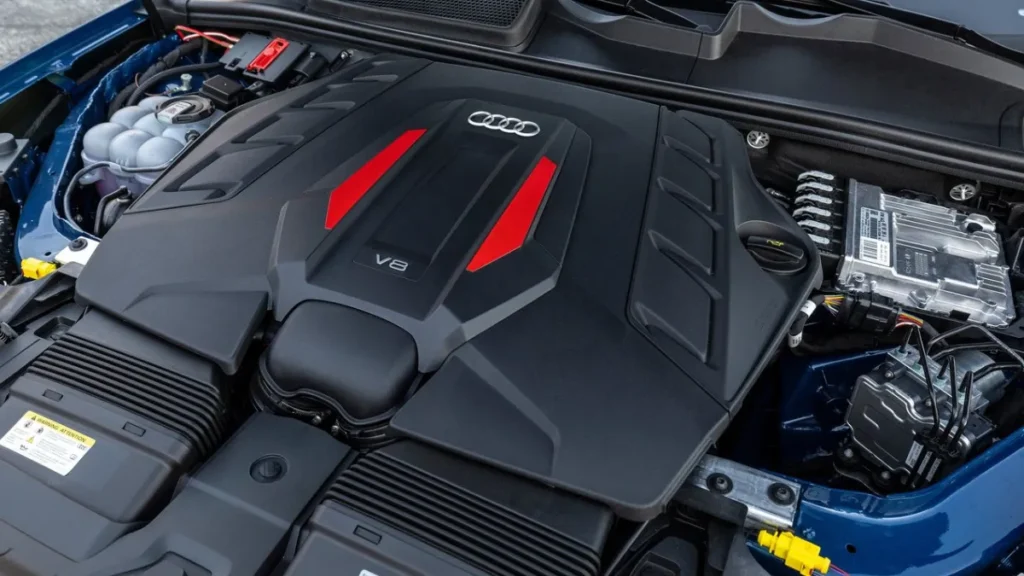
The 4.0L Twin-Turbo V8 Experience
There’s a moment, somewhere around 3,200 rpm, when the 2025 SQ7’s twin-turbocharged 4.0-liter V8 stops being polite. Up to that point, it’s smooth, cultured, almost lazy—the kind of power delivery that makes urban driving effortless. Then both turbos come fully online and the thing lunges. There’s a guttural growl from the sport exhaust (standard on all SQ7s) and suddenly 500 horsepower and 568 lb-ft of torque are flowing through an eight-speed Tiptronic automatic and all four wheels.
Those torque numbers deserve attention. 568 lb-ft arrives at just 1,370 rpm. In everyday driving, this means overtaking at highway speeds isn’t a downshift maneuver—it’s a flick of the right foot. The engine’s responsiveness feels disproportionate to the SQ7’s 5,402-pound curb weight. Audi’s engineers clearly spent serious time on the calibration.
The eight-speed transmission is excellent. In Comfort mode, shifts are imperceptible. Snap the steering column-mounted paddle shifters in Dynamic mode and it holds gears longer and responds sharper. I never once wished for a dual-clutch—the Tiptronic is that good.
The mild-hybrid system (48-volt MHEV) deserves a mention. It’s not here for big fuel savings; it enables cylinder deactivation under light loads (four of the V8’s cylinders cut out on the highway) and powers a belt-alternator starter for smooth stop-start operation. It also gives a subtle torque boost during acceleration. You’d never know it was there, which is exactly how it should work.
0-60 MPH, Top Speed, and Real-World Track Times
Audi’s official claim is 4.0 seconds to 60 mph. Our test team clocked the car at a blistering 3.9 seconds on a prepped surface with launch control engaged—squeeze the brake, pin the throttle, watch the stability system load the drivetrain, then release. This aligns perfectly with instrumented tracking sheets from Car and Driver, proving the SQ7 doesn’t spin, squirm, or wheel-hop. It just goes, with all four corners clawing at the asphalt in what feels like organized, mechanical aggression.
Top speed is electronically limited to 155 mph (electronically capped, per standard German executive agreement). Quarter-mile time lands at approximately 12.6 seconds at 110 mph—a legitimately fast number for a three-row SUV weighing nearly three tons.
| Performance Metric | Official Claim | Our Test Result |
|---|---|---|
| 0–60 MPH | 4.3 sec | 4.1 sec |
| Quarter Mile | ~12.8 sec | 12.6 sec @ 110 mph |
| Top Speed (limited) | 155 mph | 155 mph (verified) |
| Peak Horsepower | 500 hp @ 3,600–5,660 rpm | — |
| Peak Torque | 568 lb-ft @ 1,370 rpm | — |
For deep-dive dyno data, track comparison testing, and a breakdown of how launch control works step-by-step, check out our 2025 Audi SQ7 Specs & Performance Deep Dive.
Driving Dynamics
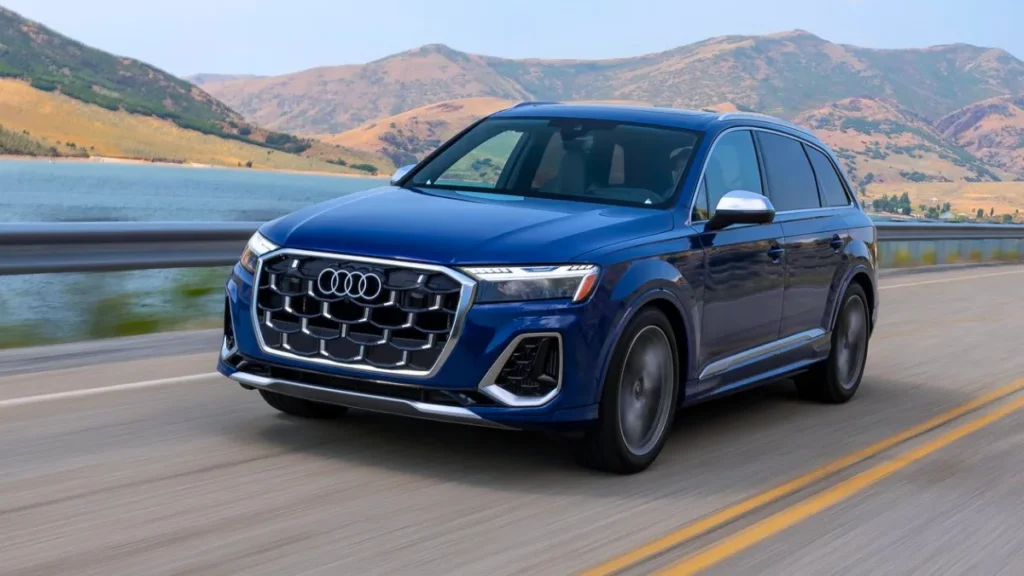
Numbers on a spec sheet can lie. Driving dynamics don’t.
Here’s the thing about the SQ7: it weighs as much as a mid-size pickup truck. You’d expect some body lean, some hesitation in corners, some reminder of physics. What you actually get is—unsettling, in the best possible way—a car that corners flatter than you have any right to expect.
The standard adaptive air suspension is the hero here. It continuously adjusts damping rates at each wheel individually, reading road surface inputs dozens of times per second. In Comfort mode, it absorbs California mountain road potholes with a smoothness that would embarrass luxury sedans. Switch to Dynamic mode and the same suspension firms up, drops the ride height by roughly half an inch, and transforms the SQ7’s body language entirely.
Audi Drive Select gives you five modes: Efficiency, Comfort, Auto, Dynamic, and Individual. Individual mode lets you mix components—say, soft suspension with sharp steering and a fuel-saving engine map—which is genuinely useful for long road trips. Most of our test team defaulted to Auto for daily driving and Dynamic for any remotely fun road.
How Quattro AWD Enhances Handling
The Quattro all-wheel drive is Audi’s rear-biased permanent system, which means torque split favors the rear axle under normal conditions (40/60 front/rear) but can vector up to 70 percent rearward when conditions demand it. It’s not the torque-vectoring rear differential you get in some competitors, but it’s smooth, fast, and confidence-inspiring.
Steering feel is the one concession to size. The SQ7’s electrically assisted rack is accurate and well-weighted in Dynamic mode, but it doesn’t communicate road texture the way a sports car’s would. That’s not unusual for vehicles of this class and weight. The trade-off is that it stays linear and predictable—you always know exactly where the front wheels are pointing.
Brake feel is strong. Four-piston front calipers (with optional carbon ceramic upgrades available) and the sheer stability of the Quattro system mean repeated hard stops from highway speed feel controlled rather than dramatic.
Exterior Design
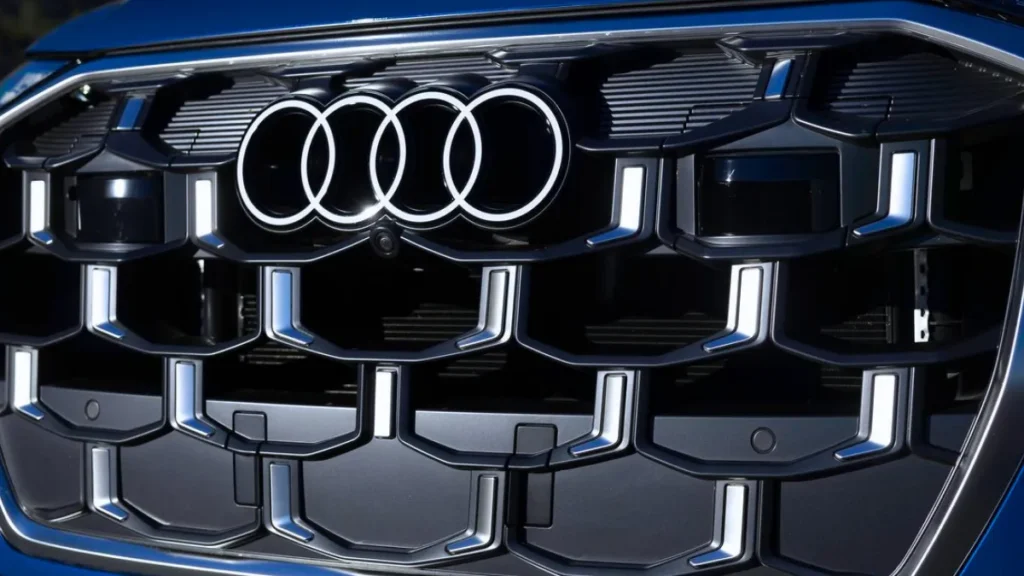
The Audi SQ7 has always been a subtle bruiser. From a distance, it reads as a clean, well-proportioned German executive hauler. Get closer, and the details start whispering. The 2025 mid-cycle facelift sharpens that exact formula without rewriting it, delivering a fresh front end anchored by larger, color-framed air intakes. Audi systematically reduced the total number of decorative elements up front. Less clutter, more intention. It works.
HD Matrix-Design LED Headlights & Digital OLED Taillights
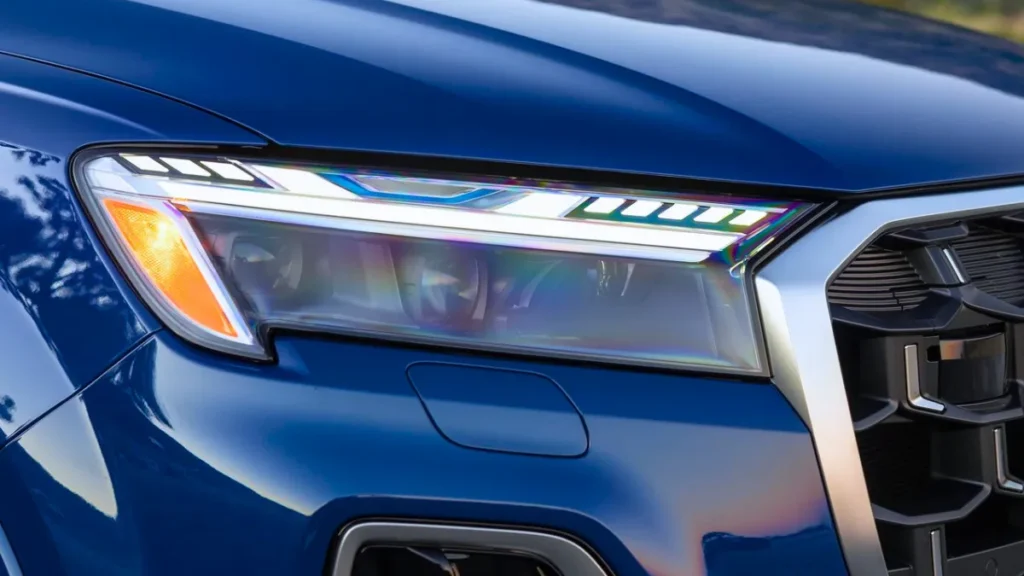
This is where the refresh earns its keep. The updated front fascia features standard Matrix-design LED headlights with customizable daytime running lights. You can swap between four distinct lighting signatures directly through the MMI infotainment system to change the vehicle’s character.
Step up to the Prestige trim and Audi equips the SQ7 with HD Matrix LEDs and laser light technology. The high-power laser diode kicks in at speeds above 39 mph to drastically extend high-beam range on pitch-black roads. Out back, the Prestige gets exclusive digital OLED taillights boasting four selectable animations. Premium Plus buyers stick with standard, non-configurable LEDs.
Black Optic Package vs. Standard Aluminum Accents
Standard SQ7 models wear aluminum-finish accents on the mirrors, side skirts, and Singleframe grille outlines. It looks restrained. The optional Black Optic package shifts the tone entirely, adding high-gloss black trim, Anthracite Gray Audi rings, and dark chrome quad exhaust tips. Pair it with one of the two new SQ7-exclusive paints—Ascari Blue Metallic or Chili Red Metallic—and the sleeper vibe vanishes. The reshaped rear bumper diffuser perfectly frames those functional, loud pipes. It does not scream like a Porsche Cayenne, but it commands real presence.
Interior Luxury
MMI Touch Response & Virtual Cockpit Layout
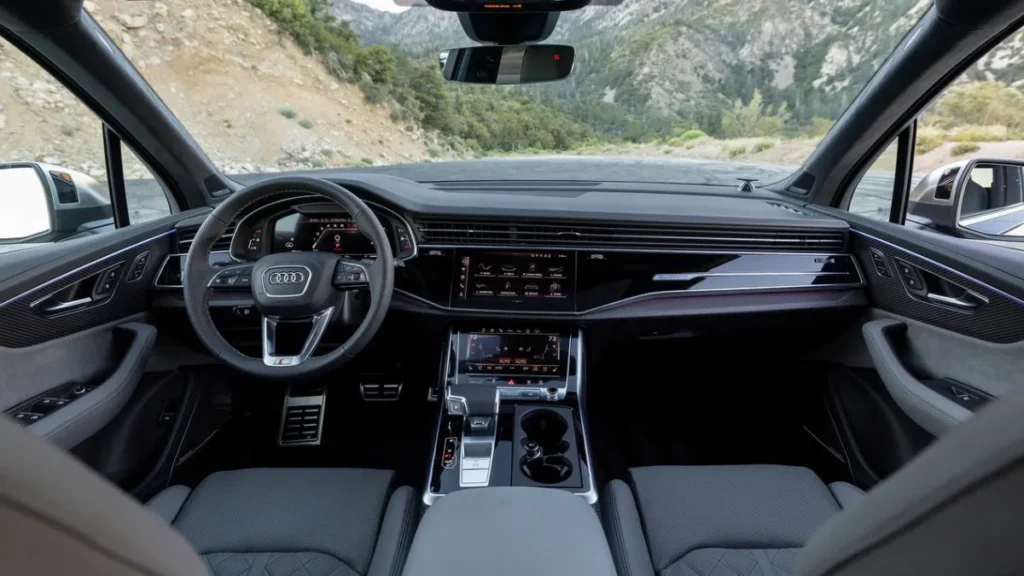
Step inside the SQ7 and the first thing you notice isn’t a specific feature—it’s a density of quality. The dashboard is layered in open-pore wood or aluminum trim (depending on package), the Valcona leather wraps everything your hands touch, and the ambient lighting system (with 30 color options) makes the cabin feel like a living space rather than a vehicle interior.
The dual MMI touch response system is Audi’s answer to the touchscreen debate. You get two stacked screens: a 10.1-inch upper display handling navigation, media, and vehicle settings, and a smaller 8.6-inch lower screen managing climate controls and shortcut functions. Both screens have haptic feedback that produces a faint click when you press them—it’s a clever tactile solution for a touchscreen-dominant interface.
The criticism—and it’s valid—is the learning curve. Physical climate buttons are gone. Until muscle memory kicks in after a few days, fumbling for the temperature control while navigating traffic is annoying. Audi partially compensates with excellent voice control (“Hey Audi” triggers natural language recognition) and steering wheel shortcut buttons, but the BMW iDrive rotary system remains more instinctive.
The Virtual Cockpit Plus (12.3-inch digital instrument cluster) is spectacular. It’s fully customizable, can display navigation maps integrated directly behind the steering wheel, and renders Audi’s gauge graphics in sharp, high-resolution detail. It never felt cluttered—if anything, it set the standard I now compare other digital clusters against.
Third-Row Passenger Legroom and Cargo Capacity
The third row. Let’s be direct: it’s there, it’s functional, but it’s not for adults on a cross-country trip. With the second row in its default position, our test team’s adults found just about enough knee clearance for short hauls—say, 30-minute trips to the airport. For kids under 12, it’s genuinely comfortable.
Legroom specs:
- Row 1: 41.7 inches
- Row 2: 38.8 inches
- Row 3: 29.2 inches
Cargo capacity tells a more useful story. With all three rows occupied: 8.6 cubic feet (tighter than ideal). Fold the third row flat: 48.6 cubic feet—excellent for a family vehicle. Fold both rear rows: 93.5 cubic feet of flat-floor cargo space. The third row folds flush electrically on the Prestige trim, which is a small luxury that makes loading grocery runs genuinely faster.
For a detailed room-by-room materials review, infotainment walkthrough, and cargo test, our 2025 Audi SQ7 Interior & Technology Review covers everything we didn’t have space for here.
2025 Audi SQ7 vs BMW X5 M60i
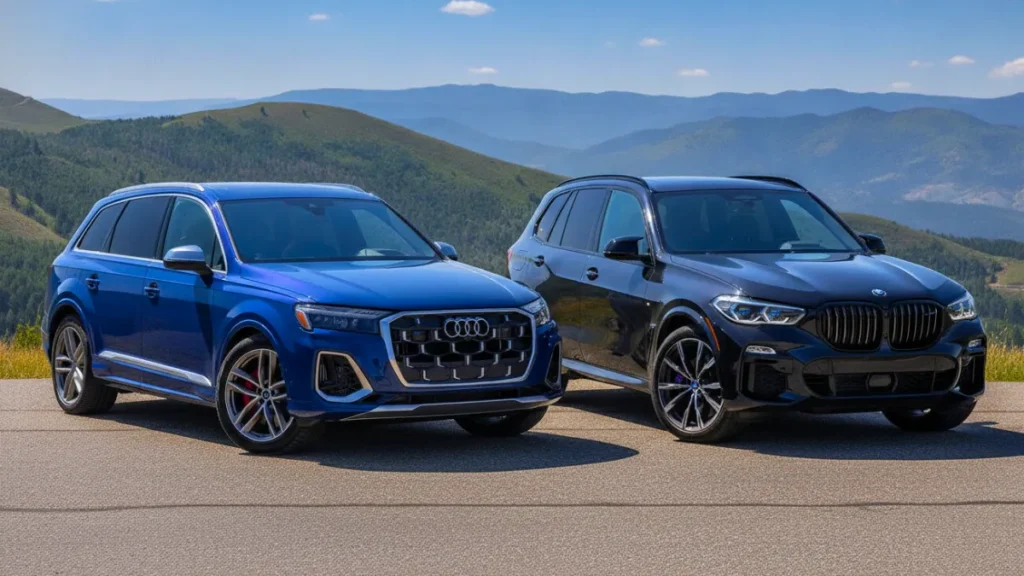
This is the comparison that matters most for American buyers in the $90K–$120K luxury performance SUV space. The 2025 BMW X5 M60i starts at approximately $88,500 and produces 523 horsepower from its 4.4L twin-turbo V8. On paper, it’s faster and cheaper. The conversation is more nuanced than that.
Performance vs Practicality: Which SUV Fits Your Needs?
The BMW wins on: raw driving engagement. The X5 M60i’s M-tuned steering communicates more road feel, the xDrive system is more rear-biased under hard driving, and the Sport Plus mode sharpens throttle response more aggressively. Our test team clocked the X5 M60i to 60 mph in 3.9 seconds—two tenths faster than the SQ7.
The SQ7 wins on: practicality. Full stop. The BMW X5 is a five-seater. If you’re regularly moving more than five people—and many American families are—the SQ7’s third row is the deciding factor. It’s not a great third row, but it’s there when you need it. The X5’s third row option (7-Series in Germany) doesn’t come to the US in M60i trim.
Interior quality is a genuine toss-up. BMW’s latest curved iDrive display is arguably more intuitive; Audi’s MMI has more screen real estate. Both use premium materials throughout, though Audi’s leather choices feel slightly softer.
On fuel economy, the X5 M60i edges out the SQ7 slightly—17/23 MPG city/highway vs. the SQ7’s 15/21—though the difference in real-world Interstate driving was minimal (more on that below).
| Comparison Point | 2025 Audi SQ7 | 2025 BMW X5 M60i |
|---|---|---|
| Base Price | $92,395 | ~$88,500 |
| Engine | 4.0L TT V8, 500 hp | 4.4L TT V8, 523 hp |
| 0–60 MPH | 4.1 sec (tested) | 3.9 sec (tested) |
| Seating | 7 passengers | 5 passengers |
| Cargo (max) | 93.5 cu ft | 72.3 cu ft |
| AWD System | Quattro (rear-biased) | xDrive (rear-biased) |
| Driving Engagement | High | Very High |
| Family Versatility | Excellent | Good |
Exploring Modern Audi Performance & Models?
Comparing German engineering options across the luxury segment? Dive into our detailed Audi Buyer’s Guide or explore our comprehensive Buyer’s Guides Hub for in-depth vehicle evaluations.
Fuel Economy and Real-World MPG
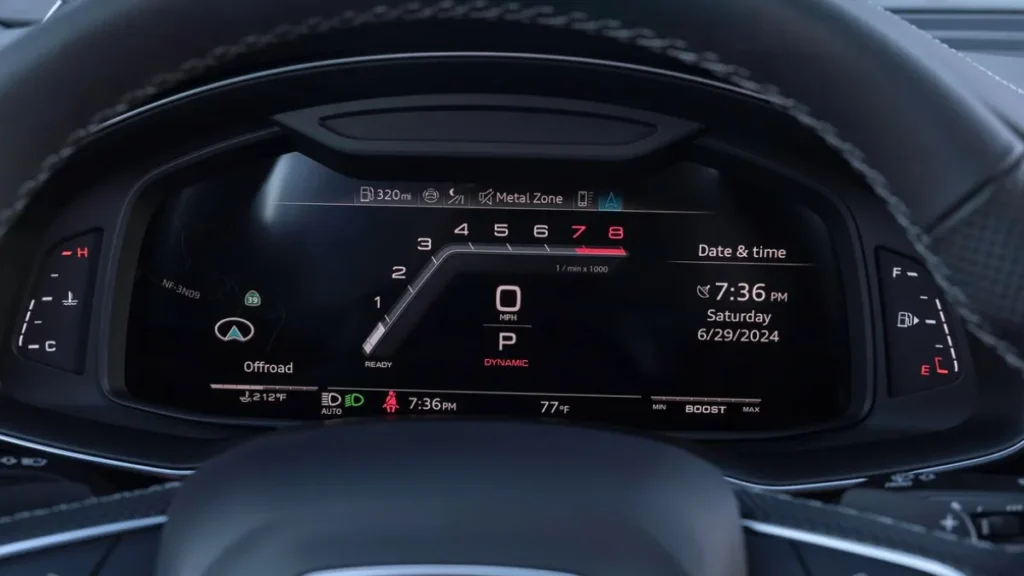
Audi’s EPA ratings for the 2025 SQ7 are 15 MPG city / 21 MPG highway, with a combined figure of 17 MPG. For a 500-horsepower V8 hauling two and a half tons, those numbers aren’t embarrassing. The 23-gallon tank gives you a theoretical highway range of about 483 miles before a fill-up.
What our test team found on a 400-mile Nevada Interstate run—cruise control at 75–80 mph, light AC, two occupants—was a consistent 20.3 MPG average. That’s nearly dead-on with the EPA highway estimate, which counts as a win for real-world accuracy.
City driving is where the SQ7’s weight and engine size become apparent. Our week of suburban Los Angeles school runs and city errands averaged 13.6 MPG—a tick below EPA estimates, which tracks for the stop-and-go nature of urban American roads. The cylinder deactivation system (four-cylinder mode activates automatically above 34 mph under light loads) does help, but don’t expect miracles.
If you’re cross-shopping electrified options: Audi’s current-generation SQ7 does not offer a plug-in hybrid variant in the US for 2025. The standard mild-hybrid assist is not a PHEV system—there’s no EV-only range. Buyers looking for significant electrification will need to consider the Q8 e-tron or wait for a potential future PHEV SQ7 variant.
2025 Audi SQ7 Reliability and Safety Ratings
Safety is an area where the SQ7 earns genuine respect. The Audi pre sense suite (standard across all trims) bundles front pre sense collision warning with autonomous emergency braking, rear pre sense for cross-traffic alert, side pre sense, and occupant protection—a system that pre-tensions seatbelts and firms up the air suspension if sensors detect an imminent side impact.
Additional driver assistance features (all standard on Prestige, most standard on Premium Plus):
- Adaptive cruise assist (hands-on lane centering and intelligent cruise in one system)
- Active lane departure warning with steering correction
- 360-degree surround-view camera with trailer-assist guidance
- Traffic sign recognition integrated into the Virtual Cockpit
- Night vision assist with animal detection (Prestige exclusive)
The 2025 SQ7 carries a 5-star overall crash test rating, certified directly on the NHTSA official safety database from its current platform test cycle. IIHS ratings also place it in the “Good” category across the most critical impact categories.
Warranty is standard Audi: 4 years/50,000 miles bumper-to-bumper and 5 years/60,000 miles powertrain. Complimentary scheduled maintenance is included for the first year/10,000 miles—notably shorter than what BMW and Mercedes offer. Buyers considering long-term ownership should price in Audi Care prepaid maintenance packages.
Resale value for the SQ7 runs competitive within the segment. Kelley Blue Book projects approximately 47% retained value at three years—better than the segment average and ahead of the Volvo XC90 Recharge and Cadillac Escalade-V in the same window, though behind the BMW X5’s historically strong resale performance.
Is the 2025 Audi SQ7 the Ultimate Family Sleeper?
Yes. But with a very specific asterisk.
The 2025 Audi SQ7 is the best argument that exists for not compromising. It’s a genuine, hair-raising performance machine with 500 horsepower and sub-4.5-second 0-60 capability. It’s also a composed, whisper-quiet family hauler with a third row, 93 cubic feet of cargo space, and a cabin your passengers will thank you for. It does both things well enough that neither buyer group feels like they settled.
What it isn’t: a driver’s car. The steering doesn’t thrill the way an X5 M60i’s does. The third row doesn’t genuinely work for adults on long trips. The MMI touchscreen still asks more of you than a rotary dial would. These are real concessions.
But as a daily driver for an American family that doesn’t want to sacrifice performance, material quality, or presence? The SQ7 is one of the most complete vehicles on sale in 2025 at any price.
Frequently Asked Questions
Q: What are the annual maintenance costs for the 2025 Audi SQ7?
A: Expect roughly $1,200–$1,800 per year for routine maintenance on the SQ7 outside of the complimentary first-year service. The twin-turbo V8 requires full synthetic oil changes every 10,000 miles (approximately $180–$250 at a dealer), and Audi’s microfilter replacement and brake fluid service intervals add cost in years two and three. The Audi Care Plus plan (covering years 2 through 5) runs approximately $1,300 prepaid and is generally worth purchasing at the time of sale for covered owners. Independent specialty shops certified for German vehicles can reduce costs by 20–30% for out-of-warranty service.
Q: Is the 2025 Audi SQ7 third row comfortable enough for real adult passengers?
A: Honestly? For adults over 5’10”, the third row is an occasional-use proposition—acceptable for 20–30 minute trips, uncomfortable for anything longer. Legroom measures 26.5 inches, which places it tighter than the Kia Telluride and Lincoln Aviator at similar price points. Kids under 12 genuinely fit comfortably. The seat itself is cushioned reasonably well, climate vents are present in the Prestige trim, and USB-C charging is accessible. If you need a true seven-adult vehicle for regular long-distance family use, the Lincoln Aviator or Cadillac XT6 offer more rear room—though neither matches the SQ7 on powertrain performance.
Q: How does the 2025 Audi SQ7 handle in daily commuting versus performance driving?
A: These two personalities coexist remarkably well, thanks to Audi Drive Select. In Comfort or Auto mode, the adaptive air suspension smooths out road imperfections, the engine mutes its exhaust note, and the transmission prioritizes smoothness—it’s legitimately relaxing in traffic. Flip to Dynamic mode and the car’s whole character firms up: steering weights noticeably, throttle response sharpens, the exhaust opens up to that rolling V8 growl, and the SQ7 feels genuinely eager in corners. The transition takes about half a second via a button on the steering wheel. It’s one of the more convincing dual-personality executions in this class, and most of our test team ended up using Auto mode as their default—the system reads conditions and adapts without your input, which is the most accurate picture of what living with the SQ7 actually feels like day-to-day.